Future linear core TV advertising revenues will continue
to decline by 6% to 8% for the next two years, according to MoffettNathanson Research.
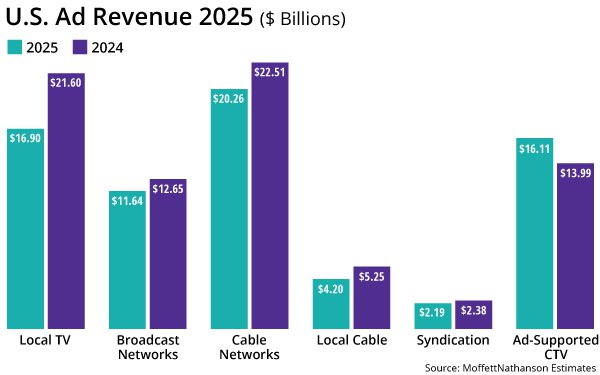
For 2025, total linear core TV ad revenues are expected to land at $55.2 billion, slipping 7% from 2024.
They are projected to decline another 6% to $51.6 billion next year and to drop 8% to $47.9 billion in 2027.
The only part of total TV’s gains is advertising-supported video-on-demand
streaming, which will rise this year by 15% to $16.1 billion.
While connected TV (CTV) will continue to gain in years to come -- $19 billion (in 2026) and $22 billion (in 2027, averaging a 16%
hike over a three-year period) -- sharper increases in the future are not expected.
“Without ad products that match the performance, targeting, and measurement advantages of the Big Tech
Four [Meta, Alphabet, Microsoft and Amazon], it’s hard to see CTV re-accelerating to prior lofty growth rates (with live sports going OTT remaining the key exception),” writes Michael
Nathanson, media analyst/cofounder of MoffettNathanson.
advertisement
advertisement
He adds: “CTV is still growing, but the category is clearly decelerating, from outsized double-digit gains in recent years to a
mid-teens trajectory going forward, as the easy lift from linear-to-CTV budget shifts fades and linear holds a floor thanks to sports and news.”
Looking at the complete, broader picture
for 2025, the biggest loser ending this year will be local TV stations, down 22% to $16.9 billion -- due to the unfavorable comparison to 2024, when high Presidential advertising and Olympic gains
were made.
National broadcast networks are estimated to sink 8% ($11.6 billion), with national cable networks declining 10% ($20.3 billion), local cable by 20% ($4.2 billion) and syndication
by 8% ($2.2 billion).