If you commuted into New York City on the Metro-North railroad this first Monday
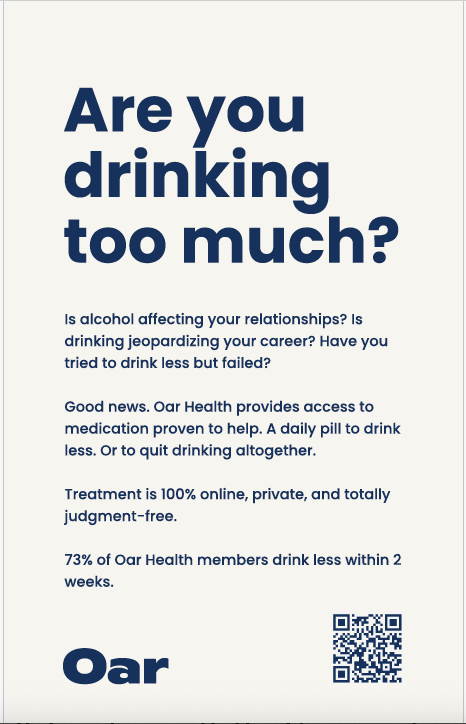
of the new year, you may have seen at least one of three ads placed by Oar Health via Quan Media to promote its naltrexone pill, which combats alcohol addiction.
“We tend to
target people who are more affluent, and Metro North serves some of the most affluent zip codes,” Oar Vice President of Growth Neil Walker tells Marketing Daily.
Besides
affluence, Walker says the brand’s target is largely people in their mid-40s with a good education, “perhaps middle managers,” who have “young kids, aging parents, mortgages,
bills and other responsibilities” that make them “more prone to alcohol abuse. All those things drive their stress, and so they often use alcohol as a crutch.”
advertisement
advertisement
Coming largely
before New Year’s resolutions to quit or cut down alcohol use can be broken, the timing of the Metro-North campaign represents Oar’s first opportunity to reach those commuters since their
likely drinking on New Year's Eve. “They’re back at work and headed into the office,” Walker says, adding that commuters are more open to think about making changes precisely while
on their twice-daily train rides: “in the morning when they’re feeling the effects of the night before” and “the end of the working day, when they might start to experience
cravings.”
Mondays are also Oar’s strongest day of the week for getting new users. It's also the first working day of Dry January, which ranks as one of Oar’s biggest
months.
Walker says that’s largely because “anytime the cultural zeitgeist refocuses on people’s relationship with alcohol…people try to go it (quitting or cutting
back) alone and then realize it’s much harder than they expected.”
“People say to themselves, ‘I’m going to quit drinking for a month,’ and then, a week or
two in, they’re struggling much more than they expected. That’s a moment when they realize that perhaps some form of support would be beneficiary.”
Backing up the use of
Metro North, an Oar survey conducted in December found that 55% of Dry January participants earn more than $250,000 annually, with millennials (29-44) making up 51% of the total.
Walker, who
before joining Oar in 2023 held a similar position at Ro, says commuter rail had proven quite effective for that telehealth brand. He's found that, “either for ED or GLP-1s, what media worked
for an audience there [at Rop] is often a good indicator that it’s going to work for alcohol use disorder.”
The month-long Oar campaign, the company’s first out-of-home
advertising of any type, consists of 273 card ads across all three of Metro North’s train lines: the Hudson, Harlem and New Haven.
One of the ads shows an Oar bottle and the headline
“A daily pill to drink less or quit.” Another shows the bottle, a headline ”Drinking too much,” and additional copy noting that “73% of Oar Health members drink less
within 2 weeks.”
All ads carry a QR code connecting to Oar’s telehealth site, which Walker says will provide Oar with “a sense of the traffic that each ad
generates.”
“We don't want to be shouting,” Walker explains about the content, which was created in-house. “We want to be quietly there." He calls it “simple,
direct, judgment-free messaging that cuts to the quick and lets them [commuters] know this thing [Oar] exists and may be able to help and worth checking out.”
“With transit, you
get repeated exposures because you’re commuting in and out of Grand Central several times a week,” he adds.
Relating that the campaign is essentially functioning as a test, Walker
says that future iterations could use the Long Island Railroad and New Jersey Transit -- and, in other markets, BARR in San Francisco and commuter trains in Chicago,
Results that will help
determine such future plans include “higher recall and strong perceptions of trust and legitimacy.”