From AI mirrors to infrared haircare,
beauty brands brought real innovation to Las Vegas. Companies showcased the many ways they are turning surface-level skin data into personalization and problem-solving, giving brands new ways to drive
sales, engagement and loyalty.
L’Oréal drew heavy interest with two light-powered tools. First, for hair, it debuted the Light Straight + Multi-Styler, which uses infrared tech to
style hair at 320°F, far lower than the typical 400°F of hair dryers. The company says it works three times faster while reducing heat damage.
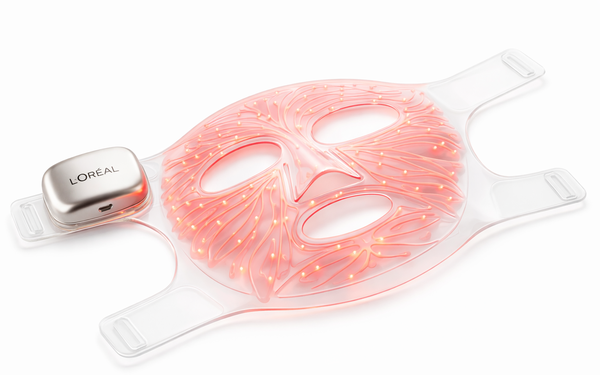
L’Oréal also unveiled a new
LED Face Mask that’s flexible, see-through and ultra-thin—an upgrade from the rigid LED masks that have dominated the category. The mask uses targeted red and near-infrared light to
address fine lines, sagging and uneven skin tone.
advertisement
advertisement
Samsung stepped further into beauty with its oval AI Beauty Mirror, developed with Amorepacific. Its hybrid polarized/half-mirror design
improves reflectivity and transparency, delivering clearer diagnostics. Using camera-based optical analysis, it assesses pores, redness, pigmentation and wrinkles, then recommends customized
routines.
Amorepacific also introduced Skinsight, an Innovation Award honoree co-developed with MIT researchers. The “electronic skin” platform uses a wearable sensor patch to read
multiple aging factors in real time, predict future aging, and recommend personalized solutions.
Kiehl’s earned an Innovation Award in AI for its Derma-Reader 2.0, a clinical-grade
in-store diagnostic tool. Using tripolar lighting, it captures nine high-resolution images and analyzes 11 surface and subsurface attributes. Powered by L’Oréal research and trained on
more than 16,000 clinical images, it delivers dermatologist-level insights in minutes, which Kiehl’s Skin Pros translate into full-face skincare regimens, according to the company.
Another award winner, Kolmar Korea’s Scar Beauty Device, combines scar treatment and cosmetic coverage in a single system. Users snap a smartphone photo; AI classifies the scar into one of 12
types and recommends a customized treatment. At the same time, the device blends and sprays a match from more than 180 skin-tone shades, using an inkjet-like process for precise, heat-free
application.
The upshot: CES signaled a shift from beauty gadgets to diagnostic ecosystems, where computer vision, optics and AI enable more personalized products—and more informed
skincare.