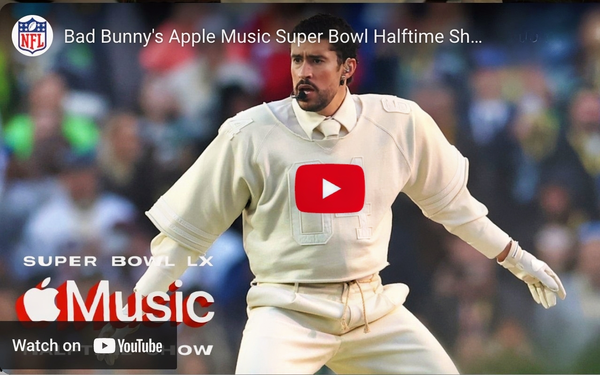
Few events in our American life are as unifying as the Super
Bowl.
So, when the National Football League puts on a controversial halftime show, the big day's unifying effect goes out the window.
For millions, the tone of
Bad Bunny’s halftime show was off-key, off-putting and inappropriate for an all-American pseudo-holiday such as Super Sunday.
The word “all” is
italicized here to emphasize the intended usage of the phrase “all-American.”
It is not used here in an exclusionary way implying that many Americans are not
necessarily to be considered “all-American.”
On the contrary, “all-American” means what it says: all Americans, most of whom are the descendants of
immigrants, or they are first-generation immigrants who have arrived here only recently and speak their native languages at home and in their communities.
advertisement
advertisement
How many groups are there
in America whose cultures, customs and languages originated elsewhere? A thousand? Ten thousand? More?
An estimated 14% of the U.S. population five years of age and over speak
Spanish at home -- approximately 45 million – according to United States Census data. Spanish is the second most-spoken
language in the U.S. after English.
That is no small number. But staging a Super Bowl halftime show rendered entirely in Spanish is exclusionary to everybody else.
The reverse does not seem to be exclusionary, however -- that is, mounting Super Bowl halftime shows in English.
Nearly three-quarters of Spanish speakers in America also
speak English (source: Pew Research Center).
As a counterpoint to the criticism leveled at the NFL
for putting on this all-Spanish show, many in the media applauded the performance for celebrating Latino culture in the U.S., and saluting the many countries in the Americas where Spanish-speaking
immigrants come from.
Many of the critics say the performance of Bad Bunny, 31 -- a rapper born Benito Antonio Martínez Ocasio on March 10, 1994, in Bayamón, Puerto
Rico -- contained political messages in protest of the U.S. government's heavy-handed (to say the least) approach to rounding up illegal immigrants.
Maybe the performance contained
protest messages or maybe it did not. I am in no position to know because I speak very little Spanish, which is kind of the point here.
In addition to the language and culture
barriers erected by Bad Bunny's halftime show, much of the criticism was focused on the rapper's repeated crotch-grabbing and his dancers, whose twerking and other moves were derided as
family-unfriendly.
Many also called out the dance performances as offensive because the choreography positioned the women as mere sex objects whose only purpose was to be ogled by
men, especially Bad Bunny himself.
Let the record show that Bad Bunny's halftime show averaged a total audience of 128.2 million viewers, a bump up from the game itself, which
averaged 124.9 million, according to Nielsen.
Pre-game publicity – both pro and con – likely drew a good deal of the viewership to the halftime show.
The Super Bowl is certainly a rich stew of mixed messages and crosscurrents. While Bad Bunny's performance was criticized as anti-American, patriotism still got its due at the Big Game.
As is customary, America was amply saluted in the hour leading up to kickoff. There were the usual flyovers of military jets in formation and a color guard whose members represented all
of the U.S. military services.
A particularly stirring image appeared during the singing of “America the Beautiful” by Brandi Carlile -- the sight of the members of the
United States Air Force’s 332nd Air Expeditionary Wing all standing at attention in an aircraft hangar in the Middle East (exact location not provided).
Carlile did a great job
with “America the Beautiful.” By contrast, singer-songwriter Charlie Puth's performance of “The Star-Spangled Banner” was one of those renditions that will not be remembered
for long.
However, right in the midst of all this patriotic symbolism, Green Day appeared to perform “American Idiot.” Well, at least it was in English!