The advocacy group Electronic Privacy Information Center is
asking an appellate court to reject retailers' challenge to a New York state law requiring companies that use algorithms for personalized pricing to disclose that practice to consumers.
"The state’s power to mandate commercial disclosures is especially important in the digital age, where large corporations collect and process individuals’ data in opaque
ways with dramatic impacts on consumers’ lives," the organization writes in a friend-of-the-court brief filed Tuesday with the 2nd Circuit Court of Appeals.
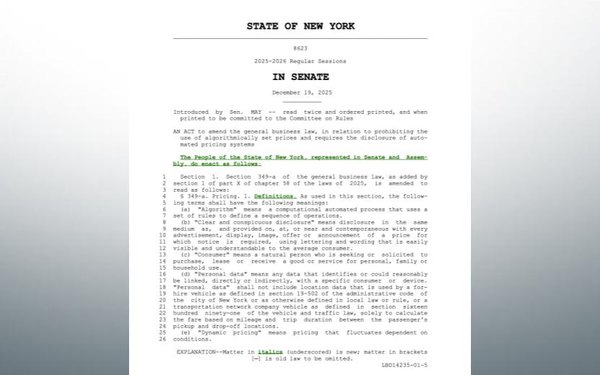
New York's Algorithmic Pricing Disclosure Act, which took effect November 10, applies when companies use algorithms to set prices based on data
that's linkable to consumers or their devices. The law specifically requires companies engaged in that activity to make the following disclosure: “This price was set by an algorithm using your
personal data."
advertisement
advertisement
The National Retail Federation sued last year to block the law, arguing the statute violates the First Amendment by forcing companies to display warnings.
U.S. District Court Judge Jed Rakoff in New York dismissed the retail organization's complaint last October, ruling that the law merely requires companies to make factual statements
about their use of algorithms.
He added that the statute is "reasonably related to government's legitimate interest" in ensuring that consumers are informed about pricing.
The retailers' group is now appealing to the 2nd Circuit, arguing that the required disclosure "gratuitously causes consumers to feel they are being manipulated for profit, when, in
reality, the retailer may simply be offering a small discount."
New York Attorney General Letitia James countered in papers filed this week that the law furthers the
government's legitimate interest in informing consumers about pricing.
"The growing use of personalized algorithmic pricing to charge consumers different prices for the same
goods and services, by culling reams of personal data, has elicited justifiable concerns about fairness, personal privacy, and disparate impact," the attorney general's office writes.
The Electronic Privacy Information Center argues in its friend-of-the-court brief that the disclosure requirement "informs consumers of a commercial practice affecting everyday
purchases about which they otherwise have no notice."
The group adds: "Armed with this knowledge, consumers may choose to shop around. The disclosures also benefit consumers by
helping them understand the practice’s impact on the economy and society more broadly."
The 2nd Circuit hasn't yet set a date for oral arguments.