"AI continues to be a tailwind for Publicis, driving our
growth, widening the gap with competition," Publicis Groupe Chairman-CEO Arthur Sadoun's first quarter 2026 earnings statement.
I've been keeping a close eye on the share of the
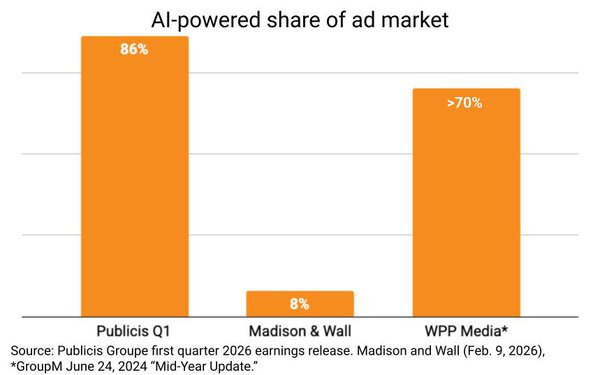
ad market being attributed to AI "empowerment" or "enablement" ever since GroupM (now WPP Media) first benchmarked it at 44% in April 2022, and while the definitions may be semantically in the eye of
the beholder -- or as the case may be, bean-counter -- the share keeps rising at the expense of human-enabled ways of doing things.
GroupM, in fact, boosted its estimate for AI-enablement to
69.5% of the advertising marketplace in its June 2024 mid-year update (the last one I have a hard number from WPP
for), and projected it would rise to 94.1% of the ad market by 2029.
advertisement
advertisement
While those projections were qualified as forecasts, Publicis Groupe put a startlingly hard number -- one accountable to
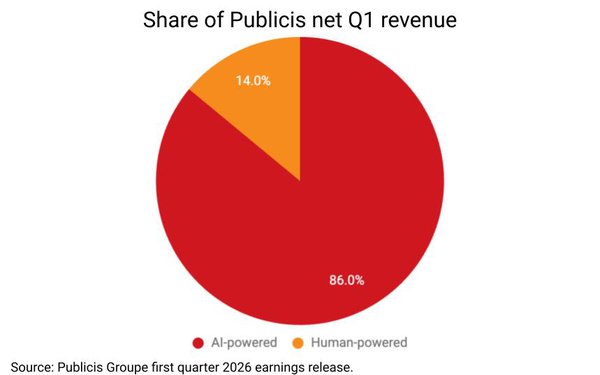
Sarbanes-Oxley-grade reporting -- in its first quarter 2026 earning release, attributing 86% of its total net revenue for the quarter to AI-powered apparatus.
"Tailwind" indeed.
At a
time when AI-empowerment has become ubiquitous to ad industry competitive touting, Publicis has created a new line in the sand for the other holdcos to catch up to. As far as I know, with the
exception of WPP Media's Business Intelligence unit's industry forecasts, no other agency holding company has put so much stock on its share of AI empowerment, though others -- especially Omnicom's
Jon Wren -- have routinely touted their AI progress in more generalized, non-numerical terms.
While Publicis did not tout its share of human-empowerment, the inverse of its earnings release
state is that it has fallen to 14% of its total enterprise. Read into that what you want.
A far more sobering AI-powered share of the ad market figure -- 8% -- was published by the analysts at Madison and Wall recently, raising interesting questions about the spread in
the deltas, not to mention how each source is attributing AI power.
"We defined the concept of AI advertising more narrowly (covering campaign spending that flows through platforms where AI
controls targeting, bidding, budget allocation, placement, and ongoing optimization with minimal human intervention) representing less than 10% of the total industry’s activity," Madison and
Wall acknowledged in a post published this morning in response to Publicis' earnings statement,
adding, "Nonetheless, the notion that agencies are already widely reliant on – and even benefitting from – AI is very real, and should help remind observers that AI is unlikely to harm
agencies. It’s at least as likely to help given the growing array of services marketers now need to learn to work with and the human judgement required to make the most of coordinating all
of them."