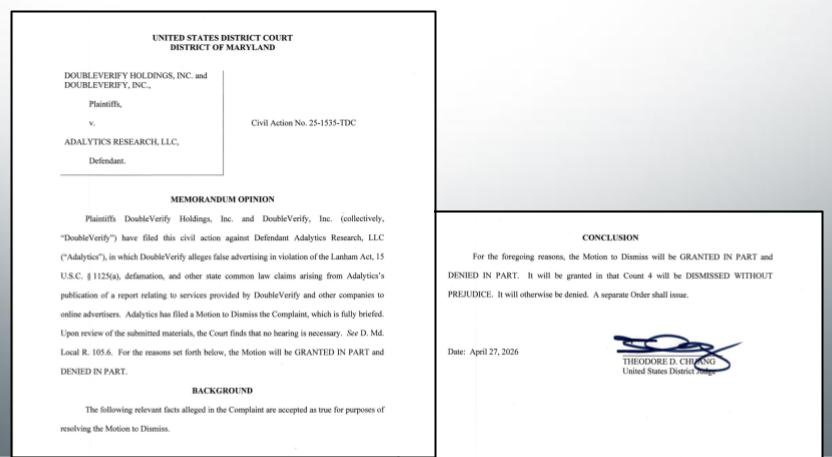
DoubleVerify can proceed with
defamation and false advertising claims against analytics company Adalytics over its March 2025 report regarding invalid traffic, a federal judge in Maryland ruled Monday.
The
ruling, issued by U.S. District Judge Theodore Chuang, comes in a dispute dating to last year, when DoubleVerify sued Adalytics over statements in the report "On pre-bid bot detection and filtration -- Are ad tech vendors serving US Government and Fortune 500 brands’ digital ads
to bots?"
Adalytics wrote that its research "suggested that advertisers were billed by ad tech vendors for ad impressions served to declared bots operating out of known data
center server farms."
The report mentioned several ad verification companies, including DoubleVerify.
advertisement
advertisement
DoubleVerify alleged in its complaint that
statements in the report "falsely assert and imply that DoubleVerify’s services are ineffective and that DoubleVerify’s customers routinely pay for advertising impressions that are served
to robotic agents ('bots'), referred to as invalid traffic ('IVT'), rather than to genuine human consumers."
Before filing suit, DoubleVerify posted a rebuttal of the Adalytics report, calling it "inaccurate and misleading."
DoubleVerify specifically said that if invalid traffic isn't filtered out pre-bid, it's removed post-bid from the billable impressions shared with advertisers.
Subsequent to the Adalytics report's publication, the Media Ratings Council said in a separate rebuttal that Adalytics focused on pre-bid detection and
filtration, but the industry standard relies on a back-end process that filters invalid traffic after ads are served.
Last year, Adalytics urged Chuang to throw out the lawsuit at an early stage, arguing that the
allegations, even if proven true, wouldn't establish false advertising or defamation.
Among other contentions, the analytics firm argued that the false advertising claim should
be dismissed because the report wasn't commercial speech.
Adalytics also argued that the report was focused only on "pre-bid" services, and didn't assess the overall
effectiveness of any vendor.
The company added that the report "never states or implies that DoubleVerify customers were actually billed for specific ads that appear to have
been served on bots."
DoubleVerify countered that Adalytics omitted a "core fact" from its report -- that "DoubleVerify’s systems filter bot traffic downstream via
'post-serve' solutions, consistent with industry guidelines published by the Media Ratings Council."
That omission rendered the Adalytics report "intentionally factually
incorrect," DoubleVerify argued.
Chuang said DoubleVerify could proceed with the false advertising claim because it alleged that Adalytics had an economic motive for creating
the report.
"The complaint alleges that Adalytics sells an 'ad transparency service that competes with DoubleVerify,' that the report was published on Adalytics' website, on
which the company's services are also advertised, and that such reports on posted on the website 'for marketing purposes,'" Chuang wrote.
He added that even though the report
"reads more like an analysis of other products and related technology than a communication aimed at selling Adalytics' own goods or services," DoubleVerify alleged that Adalytics publishes research to
promote its own platform.
But Chuang also said DoubleVerify would only be able to prevail on its false advertising claim if it presented evidence that Adalytics actually issued
the report "out of an economic motivation to promote its own products or services."
The judge also allowed DoubleVerify to move forward with its "defamation by implication"
claim.
"In its most prominent claim, DoubleVerify argues that the report was defamatory by implication in that it misleadingly implied that DoubleVerify's services are
ineffective," Chuang wrote.
"At this early stage, where the Court must accept DoubleVerify's factual allegations as true and draw all reasonable inferences in its favor, the
Court finds that DoubleVerify has plausible alleged that the report falsely implies to a reasonable reader that DoubleVerify's pre-bid bot detection services are not effective at detecting the
displaying of online ads to bots, which in turn results in unwarranted charges to customers," he wrote.
Chuang dismissed a claim that Adalytics wrongly interfered with
DoubleVerify's business relations, writing that the company failed to "identify a specific relationship affected by the report." That dismissal is without prejudice, meaning DoubleVerify can revise
its allegations and attempt to bring the claim again.