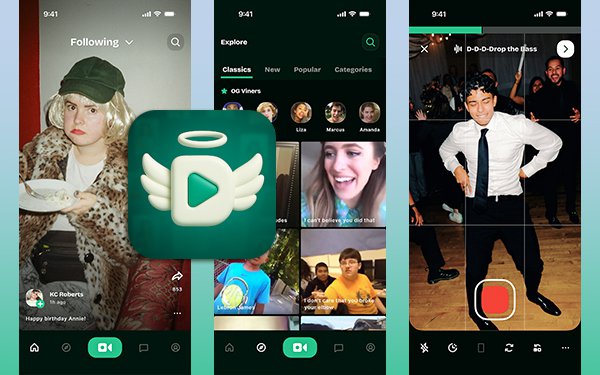
Nearly a decade since the shuttering of Vine, the beloved short-form
video-sharing app is being reimagined as “Divine,” a new mobile app backed by ex-Twitter head Jack Dorsey is inviting users to share looping videos with a six-minute time limit.
Officially, Divine is an iOS and Android app that has no direct affiliation with its defunct app predecessor Vine or the former Twitter -- which purchased the original Vine app just before it
launched in 2013.
In addition to allowing users to make and share micro videos, Divine also offers access to an archive of about half-a-million restored Vine videos, some of which have been
replayed millions of times on YouTube and TikTok since Dorsey shut down the platform in 2017.
Divine -- now funded by an open-source development collective founded by Dorsey called “and
Other Stuff” -- was created by former Twitter employee and collective member Evan Henshaw-Plath, who discovered a community-led archiving project (Archive Team) that backed up and saved a
plethora of original Vine videos.
advertisement
advertisement
<>From there, Henshaw-Plath reconstructed the video files, along with original Vine user-engagement metrics to deliver this publicly available archive
of restored content.
In launching Divine, a number of popular Vine creators -- Lele Pons, JimmyHere, MightyDuck, Jack and Jack -- have reclaimed their original accounts.
“Make
six-second loops, discover real people, and fall back in love with the kind of internet that felt alive. Weird, funny, spontaneous, brilliant. No AI slop. All human,” reads Divine's app store
description.
Furthermore, according to a recent statement, Divine aims to act as a hub for “authentic, non-AI-generated media,” ultimately valuing “creativity and constraint
over engagement for an ad algorithm.”
Divine is built on a decentralized protocol called Nostr, which, like on BlueSky or Mastodon, allows developers to create their own apps and media
servers.<./p>
To cancel out AI uploads, the platform is utilizing technology owned by the Guardian Project, a human rights nonprofit that is able to check if uploaded content was
recorded on a real smartphone.
“By bringing back Vine on a decentralized network, they are finally correcting every mistake,” Dorsey stated, adding that “a founding principle
for Divine is that creators will always be in full control of their content and followers, enabling them to create and grow their own revenue streams.”