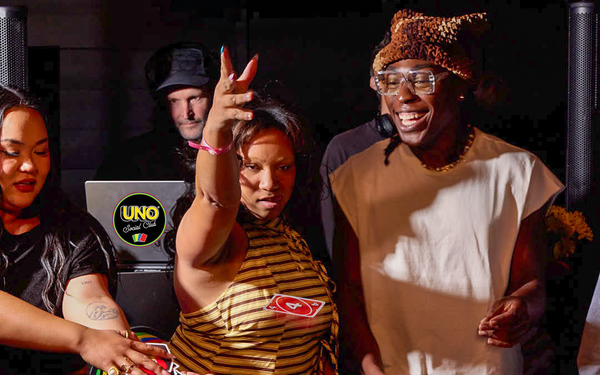
Uno, reportedly the world's most popular card game,
found an unexpected hit in last summer's "Uno Social Clubs" experiment. So this year, it's bringing the concept back and supersizing it, moving on to five U.S. cities and nine international
destinations — many of them chosen based on where fans were loudest on social media asking the tour to come next.
Mattel tested the concept last year in
a high-profile venue at the Palms Casino Resort in Las Vegas, and generated plenty of buzz — and long lines to get in — demonstrating a new way to translate fan demand into brand strategy.
The challenge isn't awareness: Uno is so familiar that Mattel estimates it sells a new deck every second, says Katie Buford, vice president and global head of Mattel Games. She tells Marketing
Daily that Uno, more than 50 years old, has posted 10 consecutive quarters of sales growth.
advertisement
advertisement
The bar takeovers further Mattel's goal to better connect
people through the power of play. Uno, easy enough for seven-year-olds, definitely rides the nostalgia and “kid-dulting” wave that millennials love — but Buford says the appeal is
wider. "This fits into the broader brand approach. Uno is a universal language. It's a game that crosses ages, generations, languages and cultures."
Mattel is
deliberately choosing locations with local flair, then backing them with local marketing. "Everything is tailored to the city, with a creator and influencer strategy," Buford says. That localization
extends to the city selection itself: after last year's debut, Mattel tracked fan commentary on social media and let the demand shape the 2025 expansion. "The list of cities we are going to this year
was absolutely influenced by what fans were asking for," Buford says.
The tour is scheduled to kick off at Kung Fu Necktie, a popular bar and music venue in
Philadelphia's Fishtown neighborhood, before moving on to Brooklyn, Miami, Houston, and Los Angeles in the U.S., and Barcelona, Berlin, London, Mexico City, Paris, Rio de Janeiro, Sydney, Tokyo, and
Toronto internationally.
Admission is free and on a first-come, first-served basis, although fans — who must be 21 or older — can RSVP ahead of
time. The tour includes Uno-themed drinks and decor, prizes, branded merch and new Uno packs.
The events also serve a straightforward commercial purpose:
Putting the game in players' hands tends to sell more of it. Mattel keeps the franchise fresh with new versions. Buford's current favorite is Uno Splash, a waterproof edition designed for poolside
play.
That momentum matters because Mattel needs it. The company is still in the midst of a long turnaround, and activist investor Southeastern Asset
Management, which owns 4% of Mattel's stock, is pushing for change — including a potential sale to private equity or a rival such as Hasbro. Sales in Mattel's games division, which also includes
building sets and action figures, grew an impressive 21% in the most recent quarter, rising to $232.6 million — making it one of the company's few clear bright spots. Overall, the El Segundo,
California-based company posted a 4% sales increase to $862.2 million in the first quarter, but that gain was offset by an 8% drop in doll sales and a 16% slide in infant and preschool offerings.
By bringing the game into bars and social spaces, Buford says, the shift is visceral. "You can see and feel that transition, with Uno going from a card game into
an immersive social experience." What she couldn't plan for was the best part: "You can never predict the in-real-life interactions — whether that means new best friends being formed, or phone
numbers being exchanged."