A Discovery Channel show
played a key role in the discovery of an airliner missing in the Atlantic Ocean for 74 years.
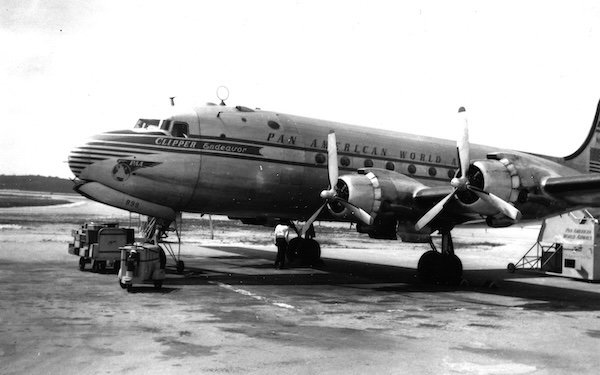
The airliner, a Douglas DC-4 Clipper passenger plane named Endeavor (above photo), is
considered to be one of the most historic airliners in post-war aviation history because the crash led to sweeping reforms in preflight safety and emergency procedures.
The wreckage was found on June 2. Discovery announced the find this week to allow time for the discovers to notify living relatives of those who perished and consult with the government
of Puerto Rico, since the crash happened shortly after takeoff from San Juan en route to New York.
The
discovery was the result of a partnership between the Discovery Channel series, “Expedition Unknown,” hosted by explorer Josh Gates, and Deep Sea Vision (DSV), a company involved in deep
ocean surveying.
advertisement
advertisement
“Expedition Unknown” first covered the story of the Clipper Endeavor -- also known as Pan Am Flight 526A -- in 2019.
That episode’s featured personality, besides the host, was Russ Matthews, president and co-founder of the
Air/Sea Heritage Foundation. Matthews leads expeditions to find significant wrecked ships and aircraft around the world.
The episode showcased Matthews’ research into Flight 526A for which he took deep dives into archival material, much of it held in the General Archives of Puerto
Rico.
His research helped narrow the search area for the Clipper Endeavor, leading, at least in part, to its discovery last month.
As in other high-profile undersea discoveries of historic wrecks in recent years, the discovery of the Clipper Endeavor was the result of technology capable of reaching
great depths that did not exist until recently.
In this case, the device used to find the plane on the ocean floor, according to Discovery, is an
“advanced autonomous underwater vehicle (AUV),” which is apparently capable of going far deeper and far more safely than a manned underwater vessel.
The AUV is one of two owned by Deep Sea Vision. The machines are Kongsberg Maritime HUGIN AUVs. Kongsberg is a technology company based in Norway.
The Kongsberg AUVs are “free-swimming drones equipped with a suite of sophisticated censors that can be
programmed to scan vast swatches of the ocean floor as deep as 6,000 meters (20,000 feet), while staying submerged for up to four days at a time, according to a Discovery Channel press
release.
“This paved the way for a new expedition to conduct an extensive subsea search that ultimately identified the wreck,” Discovery
said.
Clipper Endeavor crashed after two engines failed. The aircraft was carrying 64 passengers and five crew members.
Rescue teams from the U.S. Coast Guard and Air Force rescued 12 passengers and all five crew
members. Fifty-two passengers died. Two survivors are still living.
Naturally, the story of Clipper Endeavor and its eventual discovery
seven decades after it crashed will be featured in an episode of “Expedition Unknown.” It will air later this year on a date yet to be announced, Discovery said.