Mondelez International, owner of snacks like
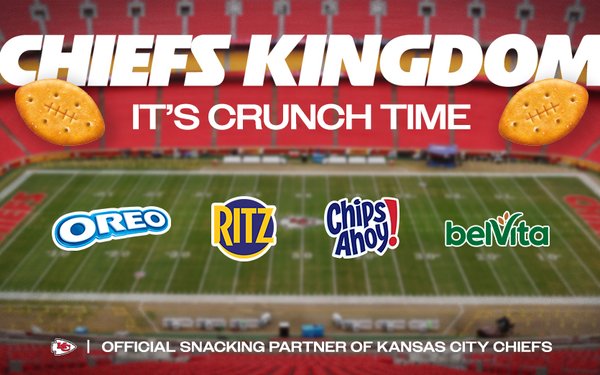
Ritz crackers, Oreos and Chips Ahoy! cookies, is revealing a marketing first for the company: It's now the official snacking partner of the Kansas City Chiefs. At the same time, it’s unveiling a
sponsorship of five powerhouse collegiate athletic programs, also making it the official snacking partner of the University of Arkansas, the University of Florida, the University of Michigan, the
University of Southern California, and the University of Texas at Austin.
Nick Rogers, director of portfolio marketing and sponsorships, tells Marketing Daily the news is big
not just because of the massive size of each of those fan bases, but because the company is catching up with the very different way today’s fans snack on sports.
Marketing Daily:
On first read, this news seems strange. Mondelez has something like $38 billion in sales and extensive global and national reach. Why is the investment in a single-team sponsorship, even if it is the
Chiefs, such a big deal?
advertisement
advertisement
Nick Rogers: These partnerships need to be regional. Every team has different nuances, different rituals. Our brands mean so much to people across the U.S., and
we need to make sure that that nuanced approach appeals to them.
In the past, brands have very much used sponsorship like a tagging exercise for brand awareness. Not for us. We’re lucky
enough to have such incredible household penetration that the awareness box is already ticked, and also from a media standpoint.
So the question becomes, "How do we go to that next
level?’" That means plugging into the fandom. This is an opportunity to grow in retail environments, through content, at the stadium, at tailgates, hosting moments at home and in people’s
pantries. Same with these colleges, which our insights tell us are multigenerational fan bases. We want to be very visible in those key moments.
Marketing Daily: Say more about the
collegiate deal. Today’s college fans probably don’t snack much differently, but they certainly interact with sports in new ways. NIL deals create new paths for fans, and they seldom watch
an actual game in the way their parents do.
Rogers: Yes. We also sponsor the NCAA and the Final Four, and these new partnerships are so flexible. They’re all season long, whether
that's football, basketball, lacrosse, soccer or baseball. That’s why it’s exciting -- we can now activate all year-round. And we’ve learned that within every college, working with
both male and female athletes, they're the ones that bring the fun. They’ve got the lighter tone, like crazy ways to consume cookies or crackers.
Marketing Daily: How do you summarize the portfolio of
sponsorships at this point? What’s the unifying strategy?
Rogers: It’s about showing up for all of these partnerships with the full portfolio, getting people to try new
products, new innovations and flavors. The strategy is to make sure we're connecting where people are consuming our products and making them aware of the rest of our portfolio.
We also love to
bring added value, including different SKUs. There used to be a Sunday or Monday football game viewing in households -- now there’s also Thursday on Amazon, and then college games. These rituals
aren’t just tentpole moments anymore; they happen every day.
Marketing Daily: What metrics matter most for these new investments?
Rogers: We wouldn’t have
signed these partnerships unless we knew we were going to drive display in-store. We’re introducing three new Oreo flavors, and all our marketing assets will ask people to vote on their
favorite. Then there will be holiday-shaped crackers. We’ll be seasonally relevant and fun, appealing to traditional shoppers and impulse buyers.
Consumers love our brands, and we don't
take that for granted. We need to make sure we're communicating in a bespoke way.
We’re measuring increases in brand sentiment, awareness of new products and new campaigns. It is really
amplifying what we have from a national level, but at a very local scale.
Marketing Daily: You’re a Brit, and have only been here for a few years, arriving from a similar role at
Cadbury in the U.K. Are all fans the same?
Rogers: U.K. football teams are hundreds of years old, so that’s different. I’ll say that U.S. fans are next-level -- like people
turning up five or six hours before a game to tailgate. I feel like I’ve gone from the frying pan to the fire. And I’ll say that my wife tells me I use the word “bonkers” a lot
more since moving here.