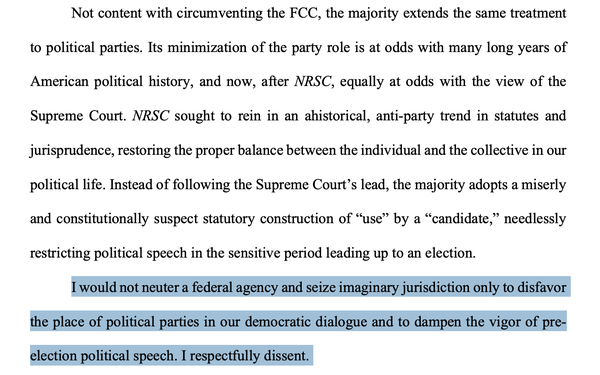
A federal court ruling has gone against a
recent Supreme Court decision that would give political parties the right to the lowest unit TV advertising rate -- not just individual candidates.
This looks to even up political
advertising strength for the midterm elections because Republican political advertising coffers are much bigger than those of the Democratic party.
Reports say the Republican National Committee has more than $100 million in cash at its disposal versus the
Democratic National Committee, which is in debt.
For decades, individual candidates for public office have been granted the right to buy TV advertising time at the lowest unit rate.
In
a recent case brought by the RNC, the Supreme Court broadened that rule to include political parties.
advertisement
advertisement
Analysts believe that if political parties can coordinate and spend together in joint TV
ads with their candidates -- and at the lowest TV unit rates -- they can gain major advantages.
Right now, major national polls show major shifts in favor of Democratic candidates having a
strong leading edge against Republican candidates.
Allowing the Republican National Committee this new pricing advantage to get the lowest TV advertising rates could help those candidates make
up significant gaps.
That said, money alone is not always the answer.
In Florida, retired U.S. Army Lieutenant Colonel Alex Vindman lost the recent Florida Democratic primary for a
U.S. Senate seat after raising over $16 million. He lost in a major upset to Florida State Representative and Democratic Socialist Angie Nixon.
Currently, there is much disruption in heavy
election seasons -- including for non-political advertisers, whose schedules can be disrupted by TV candidate campaigns have a right to get on the air.
TV stations must remove existing
commercial ads to make room for last-minute political buys.
In the past, the higher overall rush to get on the air causes massive supply and demand and pricing issues.
National parties
as well as super PACs can pay far more than candidates' campaigns.
There is one major difference remaining between political candidates' ads and those of their political parties: The latter
cannot demand to get on the air in the same way as candidates.
However, this can become murky now. If political parties are allowed to jointly buy that TV advertising time with candidates,
that will change the race.
Will TV voters see the difference? And, more importantly, will end-of-political-commercial messages explain what is going on?