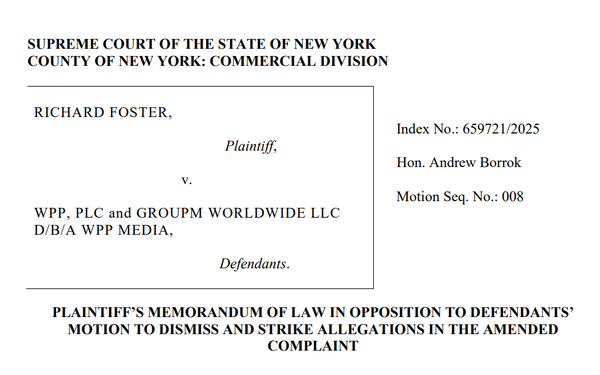
Alleged WPP whistleblower Richard Foster filed a motion Friday
opposing WPP’s request that the New York State Supreme Court judge hearing the case toss it before it goes to trial.
Foster argues that his lawsuit should move forward because he has
provided enough facts to support his claims that WPP and its media division retaliated against him after he reported what he believed were unlawful business practices—primarily misappropriating
client media rebates and repackaging them for sale by its own principal trading unit.
advertisement
advertisement
In late 2024 Foster submitted a report to WPP Media CEO Brian Lesser describing what he contended were legal and
governance problems. Last month, Foster submitted details of a separate investigation by Sony that concluded that WPP Media siphoned $350 million in media rebates in China in a single year for its own
use that properly belonged to clients. And he argues that the Sony probe backs up his own assertions that WPP wrongfully pocketed client rebates.
A separate hearing has been
scheduled for October where WPP will present its case for sealing the Sony material, which it has said is not relevant to the Foster litigation. Foster will argue why the Sony probe details should be
allowed as evidence.
According to Foster, Lesser acknowledged that the report raised "legal issues," but instead of addressing the concerns, allegedly shared the
report with an executive whom Foster had criticized.
After that, Foster says he was gradually pushed aside, excluded from important meetings and projects, and ultimately fired in July 2025.
“Defendants ask the Court to decide three questions on the pleadings: what Foster believed, what he communicated, and why he was the subject
of months of retaliation,” Foster states in his latest motion. “Each is a question of fact that is not appropriately decided on a motion to dismiss.”
He argues that the court
must assume his factual allegations are true at this early stage. He argues WPP is asking the judge to weigh evidence and resolve factual disputes, which should happen later in the case, not on a
motion to dismiss.
Foster argues that Lesser knew about his concerns, and that retaliation began shortly after his report was delivered, and that there was a
continuing pattern of adverse treatment leading up to his firing.
He also notes that in previous filings by WPP, the company’s explanation for firing him is inconsistent—that it
has characterized his departure as an "ignominious termination" while also saying it resulted from a global restructuring. Those explanations conflict and raise factual questions that should be
resolved at trial rather than be dismissed now.
Foster, who ran WPP’s content investment and branded entertainment unit, Motion, is seeking $100 million in severance and damages. He says
the company offered him a seven-figure severance package conditioned on his silence, which he says he rejected.