Every agency account lead has received some version of this email. It's short and polite. A client's new marketing director would like direct access to the campaign data, “just so
we can see things ourselves.”
You read it twice. The account has run for a year-and-a-half without a serious problem. Yet the first reaction is that an audit is coming.
That reaction is worth examining, because it rests on an assumption that no longer holds: that controlling what the client sees is part of the job.
For most of the history
of digital advertising, agency reporting worked as a filter.
Someone logged in to Google Ads, Meta and TikTok, pulled the numbers, decided which ones mattered and delivered a finished story.
The client saw the conclusion. The raw data stayed behind the curtain.
That made sense when pulling data took hours and most clients had no easy way to read it.
But it
created a habit. The curated report became the product, and the account team's value got tangled up with being the only people who could see everything.
advertisement
advertisement
So when a client asks for the
raw view, it feels like they are questioning the filter.
Usually they are not. Most clients who ask for access want to answer their CFO's questions between reports, or check spend on a Thursday
without sending an email.
That isn't distrust. That's a person effectively doing their job.
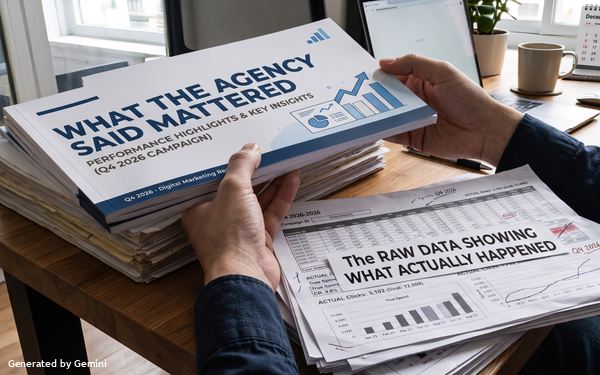
A more useful way to think about it is: the data is the evidence. Your judgment is
the verdict.
Evidence is the record of what happened: spend, impressions, conversions, CPA, ROAS. It should look the same to everyone who reads it, and anyone with access should be
able to verify it.
The verdict is something else. Is an 18% jump in cost-per-acquisition a problem, or the expected result of a promotion that ended Sunday?
Should the client
cut the weak TikTok creative, or give it another week to exit the learning phase?
Those answers depend on context that lives in the account team's heads, not in a dashboard.
Sharing the evidence doesn't hand over the verdict. It makes the verdict easier to trust, because the client can see exactly what it rests on.
Transparency, in other words,
is really about ownership, and ownership includes the numbers that make for an uncomfortable Monday call.
Curated reports make it easy to leave things out. Not dishonestly, just
selectively. A mid-month ROAS dip gets folded into a monthly average. A pacing problem fixed by Wednesday never makes the summary.
The trouble starts when the client finds one. They
pull a platform export for the CFO and spot a week nobody mentioned. Now the question isn't about that week. It's about every report the agency has ever sent.
Compare that with a
team that shows the bad week first and explains it second. The client sees the drop, reads the note on the cause and sees what has already changed. The conversation moves straight to the fix. A
problem you surface builds credibility. A problem the client finds on their own spends credibility.
This matters more now that reporting tools can write their own analysis. A growing
number of platforms read campaign data and produce a plain-English summary, complete with benchmarks and a recommended action. As a first read, that's genuinely useful.
But it's
still evidence, not the verdict. A model can tell you that CPA climbed above the category benchmark. It can't know the client is deliberately buying awareness ahead of a product launch. The more of
the analysis that gets automated, the more the human judgment on top of it becomes the actual product.
So the next time a client asks to see things for themselves, say yes. Send the
link that afternoon. Let them look at the evidence whenever they want.
The verdict is still yours. Put your name next to it.