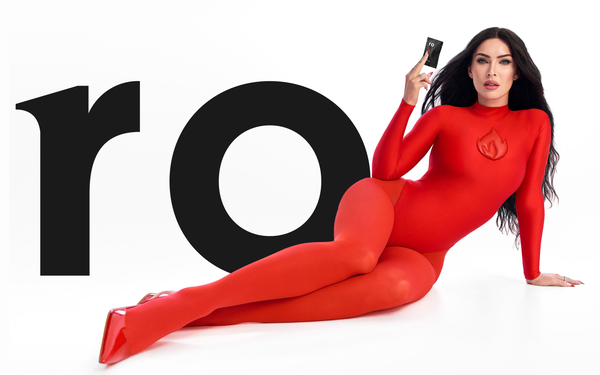
Actress Megan Fox, who has in
the past bemoaned being objectified as a “sex symbol,” today becomes the personification of an erectile dysfunction (ED) drug.
“I’m Ro Sparks, a prescription medication
for men,” Fox declares in a :30 spot while clad in a skin-tight, neck-to-toe red
catsuit. “I dissolve under your tongue, that’s for speed,” she purrs. “If prescribed, I show up right at your door. Don’t worry, my packaging is very discreet.”
She does tout product benefits, such as, “My dual action formula includes Sildenafil, the active ingredient in Viagra, plus Tadalafil, so I stay in your system ready to go for up to 36
hours.”
advertisement
advertisement
Telehealth company Ro has been selling Sparks for the past two years and the Megan Fox partnership marks not only its largest ED campaign ever, but likely the
category’s largest, Ro's co-founder and chief product officer, Saman Rahmanian, tells Marketing Daily.
The campaign, titled “Megan Fox is Ro Sparks,’ breaks today
on Paramount+ and Peacock streaming, paid social, and on linear TV during NBC/Peacock’s coverage of the decisive game three of the MLB Wild Card series between the Atlanta Braves and
Philadelphia Phillies.
In addition to four different TV iterations over the next two months, in a buy that also includes ESPN and college football among other content, Rahmanian says there
will be “hundreds of assets” on paid social as well as out-of-home (OOH) in Los Angeles and New York City.
The L.A. buy consists of billboards, with the NYC OOH including a
Times Square subway station takeover, ads in subway and Long Island Railroad train cars, and innovative wild postings in 20 locations starting next Monday, each of which will include a tear-away pad
of 18x26-inch posters, 1,000 in all, allowing passers-by to take Megan Fox…err, Ro Sparks…home with them
The company handles both creative and digital media buying
in-house, with Tatari supporting the Ro team in TV and CTV buying.
Calling the campaign “tongue-in-cheek,” Rahmanian says Ro is “leaning into Megan Fox’s
persona.”
She’s “one of the culture’s most recognizable icons,” with “the ability to take ED into the zeitgeist, into the shows and feeds where people
actually talk about sex,” he explains.
“She was excited to use her voice and persona to help couples have better sex,” he says.
A major campaign goal is to break
through the stigma that still surrounds ED.
“We wanted to make a point that when it comes to ED, desire and attraction were never the issue, but shame and embarrassment is,”
Rahmanian explains.
Using a “strong women’s voice as our spokesperson” helps to do that, he continues, noting that “nine years of marketing sexual health to men has
taught us that they really listen and lean in when a woman is part of the conversation.”
The Megan Fox partnership will extend beyond the initial campaign into the long term, Rahmanian
adds, “in the same way we have done with our other celebrity partners.”
Those celebrities – most prominently Serena Williams and Charles Barkley – have touted GLP-1s, with Rahmanian citing three
commonalities that cut across how Ro uses celebs for weight loss and ED:
- “We take on the stigma and the myths behind it.”
- “We work with the celebrity partner
in an authentic way.”
- “We always show why Ro is the better way to get care.”
They differ in one major way, though: while Williams and Barkley have both used
Ro’s GLP-1 treatments, Megan Fox obviously doesn’t use Ro Sparks.
But, says Rahmanian, “we could definitely see a celebrity partnership in the future where someone is using
the ED medication and willing to talk about it.”
That’s somewhat ironic since the very first ED ads in 1999 on behalf of Pfizer’s then-new Viagra –--which were also
among the pharma industry’s first-ever direct-to-consumer ads -- featured former U.S. Senator and Presidential candidate Bob Dole talking
about his own ED.
Even so, “ED is still a highly stigmatized condition, even more than weight loss medication,” relates Rahmanian. “It takes courage to be vulnerable and
share that story at a broad national scale.”
“ED is fairly common,” he notes, “a physical condition that happens to about 30 million men in the U.S., and it’s
treatable. But a lot of times, stigma prevents guys from getting the care they need. If our campaign helps get guys to talk to their partners and their providers, I would consider that a
win.”
The median target age for Ro Sparks is men in their mid-40s.
As for Megan Sparks’ persona, earlier this year, she showed up in a tight leather outfit for a series of
Dr. Squatch deodorant commercials in which she ordered a roomful of men to
“whip out your sticks.”