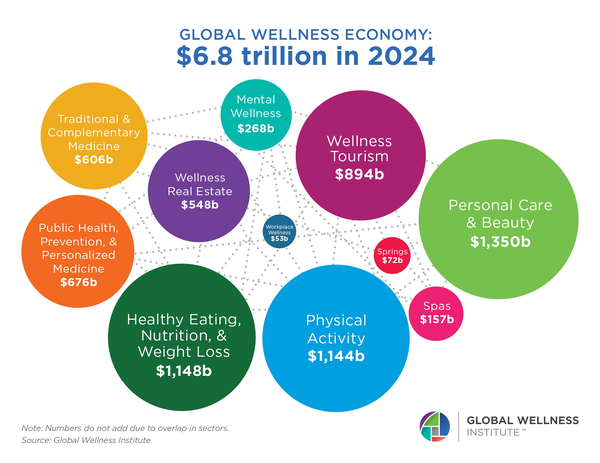
The global wellness economy reached a record
$6.8 trillion last year -- more than three times that of the pharmaceutical industry’s $1.8 trillion, according to the nonprofit Global Wellness Institute (GWI), and 60% as much as $11.2
trillion in health/medical spending by both consumers and governments.
GWI defines wellness as “the active pursuit of
activities, choices, and lifestyles that lead to a state of holistic health,” and the wellness economy as “industries that enable consumers to incorporate wellness activities and
lifestyles into their daily lives.”
North America, with $2.3 trillion in spending, led the wellness economy in 2024, followed by Asia-Pacific ($2.0 trillion) and Europe ($1.7
trillion).
GWI said the wellness market in has doubled since 2013 and grown 35% over the five years since 2019.
advertisement
advertisement
In upcoming years, GWI forecast, the wellness market will grow at 7.6%
annually, reaching $9.8 trillion by 2029, as a result of acceleration in “the trends fueling the wellness industry: an aging population, rampant chronic disease and mental unwellness, and a
market newly focused on prevention and longevity.”
Of 11 wellness categories measured by GWI, the fastest-growing -- up 17.9% year-over-year -- was real estate, defined as the
construction of properties that “incorporate intentional wellness elements.”
The next three top gainers involved destinations: spas (up 14.6%), wellness tourism (up 13.8%) and
thermal/mineral springs (up 11.1%).
The only category to fall year-over-year was workplace wellness (down 1.5%), with GWI citing employers moving away “from programmatic approaches to
employee wellness” as well as a surge in remote and “gig” work.
The predicted biggest gainers through 2029 by annual growth rate are wellness real estate (15.8%), traditional
& complementary medicine (10.8%), mental wellness (10.1%), and thermal/mineral springs (10%).
The medicine category’s projected growth, GWI said, is “not only because ayurveda,
TCM [traditional Chinese medicine] and herbal medicines are getting infused in ever more supplements/products, but because the category includes the spawning longevity and biohacking
approaches––from infrared light therapy to cryotherapy to IV drips––now ubiquitous in fitness/wellness centers, spas and resorts.”
The thermal/mineral springs
projection is largely based on “hundreds of springs-based destinations in the global investment pipeline” and on social bathhouses and water-based destinations becoming a huge global
trend.”
GWI also predicted 9.3% annual growth in the “public health, prevention and personalized medicine” category “as longevity-seeking consumers rush to diagnostic
services and personalized health optimization.”
By 2029, GWI said, six categories—personal care & beauty; healthy eating, nutrition, & weight loss; physical activity;
wellness tourism; wellness real estate; and traditional & complementary medicine—will exceed $1 trillion each in market size.
Amway, Hyatt, Kohler and 13 other brands provided
sponsorship for GWI’s research.