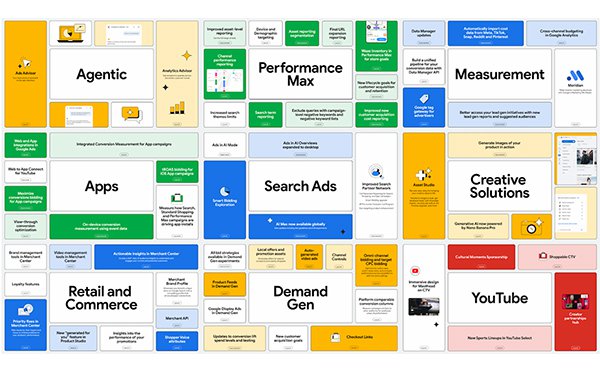
Innovation from Google in 2025 positioned brands to
tackle what comes next with greater transparency and capabilities.
Some of those include global expansion of ads in AI Overviews, AI Max for Search, controls for Performance Max,
Gemini-powered creative tools, the launch of Meridian, and new agentic tools with partnerships with PayPal and others.
The most advanced features from Google’s search and advertising
technology came from Agentic Google Ads agents to provide guidance on strategies.
Marketers in September 2018 were concerned about automation and giving up too much control of bidding and ad-serving decisions. It appears that agentic and generative AI
have changed that thought process.
advertisement
advertisement
Marketers gradually relinquished more control to Google and its ad services with the introduction of automated bidding strategies, which became dominant by
the early 2020s.
Now, in 2025, automation through agentic services optimizes campaigns — from onboarding to troubleshooting — by allowing the models to learn from the
brand’s expansive datasets, landing pages, assets and historical performance.
The Google team views automation to eliminate guesswork. Agentic-ad advisors help manage and improve
campaign performance by troubleshooting policy issues, creating new campaigns, and analyzing outcomes to improve performance.
Analytics Advisor is an in-product assistant in Google Analytics
that handles broad, top-funnel inquiries, mid-funnel behavior questions, and low-funnel, action-oriented queries.
The advisor maintains conversational memory, allowing users to ask natural
language follow-up questions to compare current data against prior insights for a continuous and iterative workflow.
Google has had some experimental tests run, ranging from placing ads in
generative AI-based search and rewriting article headlines in the company’s platform Discover
— a personalized content feed on mobile devices that recommends articles and other content based on interests — to a feature that merged AI Overviews with AI Mode in Search.
2025 marked a pivotal shift for Google Ads, from
adopting automation and generative AI for advertising to placing video content at the forefront of campaigns. The focus turned to improving conversions and controlling measurements for precision
strategies.
When Google introduced Asset Studio, a
creative tool in Google Ads, in September, the process of making campaign assets in few clicks became easier. It is powered by Nano Banana Pro, and enables generative AI tools in Asset Studio to
support the entire creative workflow.
The update helps marketers produce higher-quality content and more personalized assets, and improve performance for campaigns.
Google expanded Ads
in AI Overviews to the desktop and more countries this year. Ads are now integrated into AI-driven responses. In the U.S., Google is testing ads that appear below and in AI Mode results.
AI
Max, Google's fastest-growing AI Search ads product, has launched experiments and will expand beta text guidelines to all advertisers in early 2026.
Early this year, Google Ads launched Smart
Bidding Exploration publicly, allowing targeted return on ad spend (tROAS) campaigns to find new traffic by temporarily easing ROAS targets for more volume, a significant step in Google's AI-driven
automation that the company announced at Google Marketing Live.
Full placement reporting has been expanded on Performance Max, Search, Shopping, and App campaigns, giving advertisers more
visibility on performance on the Search Partner Network. Smart Bidding strategies were updated to work with the Search Partner Network.
At the same time, Google added its most advanced image
model, Imagen 4, a text-to-image AI model from Google DeepMind that generates high-fidelity, 2K resolution images from detailed text descriptions. The GAI model adds fine details and textures to
provide photorealistic content.
Imagen 4 will soon enable advertisers to create videos from text and images at a minimum of videos 5 seconds in length, using one image and minimal input such
as music, text, brand name and logo.
These are just some of the changes Google has made. Many more are outlined in a blog post.