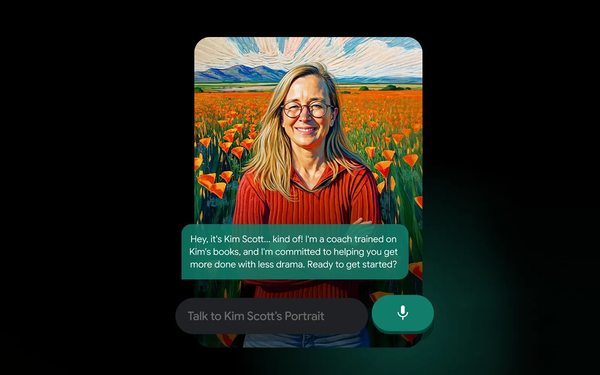
A small group of YouTube creators have agreed to allow Google Labs to
develop and showcase their likeness in the form of in-app AI avatars via the tech company's experimental “Portraits” feature.
Following several months of development, "Portraits"
allows viewers to conversationally interact with “AI representations” of real-life creators, while providing the participating creators with insights into the topics their audiences are
most interested in, YouTube's announcement explains.
Participating creators' Portraits stem from
specific content and sources that the real-life creators provided to Google Labs.
Users based in the U.S. who are 18 years or older and are viewing YouTube on a desktop may begin to see a
“Talk to Creator’s Portrait” option within a creator's channel page.
advertisement
advertisement
Users can then ask the Portrait questions directly and take part in a back-and-forth dialogue, similar to
a typical chatbot exchange.
Using Google's Gemini large language model (LLM), Portraits are designed to look and sound like the real-life creator, while also containing similar interests and
knowledge.
Depending on a creator's expertise, their Portrait aims to serve a specific purpose for curious followers.
For example, when the Portraits concept was first announced over
the summer, Google shared an AI avatar embodying Kim Scott, a bestselling author and YouTube creator whose Portrait was designed to offer users AI-powered life coaching connected to topics in her book
“Radical Candor.”
The idea of launching in-app virtual influencers has also been adopted by Meta, with Instagram inviting creators in 2024 to make AI versions of themselves within a designated AI studio that are able to
communicate with followers via direct messaging.
At the time, Meta CEO Mark Zuckerberg moved beyond fan-centric use and began testing its AI agents for brand purposes, inviting small
businesses to “press a few buttons and get an agent version of themselves that can do customer support and ecommerce support.”
TikTok also began to dabble with virtual influencers in 2024, expanding its Symphony AI ad suite with
brand-customizable digital avatars for in-app promotions and automated dubbing for global translations.
Regardless of their purpose -- whether they are used for fan engagement, practical user
questions or brand use -- AI chatbots have already become a fixture in U.S.
teenagers' lives.
The newly released study notes that two-thirds of teens between the ages of 13 and 17 say they use an AI chatbot.
With 92% of teens currently on YouTube, the
social-media platform is likely attempting to become a leading space for chatbot use among younger generations.