The Interactive Advertising Bureau on
Monday unveiled proposed draft legislation that aims to prevent generative artificial intelligence companies from scraping online content without publishers' consent.
The
proposed AI Accountability for Publishers Act would subject artificial
intelligence companies to liability for claims of "unlawful enrichment" if they scrape content in order to train their systems, create "substitutive output" of the content, or use the content in ways
that go against the publishers' terms of service.
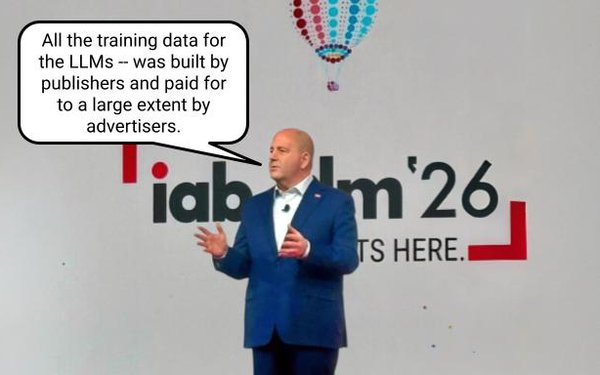
David Cohen, CEO of the ad organization, said Monday in an address at the group's annual meeting that the bill is "designed to
protect publishers from indiscriminate scraping."
advertisement
advertisement
"The internet -- the source of nearly all the training data for the LLMs -- was built by publishers and paid for to a large
extent by advertisers," he said, using an acronym for large language models. "But every single company that is training and building these AI tools without compensating publishers is free riding on
their investments."
He added: "If we keep the status quo where AI bots can leverage publisher content at will, the internet will become a shadow of itself. We don't want to
live in a world where, due to AI bots scraping publisher content without paying a dime, the publisher market disappears."
Cohen said the group will "socialize this bill with
legislators on the Hill in committees of jurisdiction, as well as members who share our concerns, and work with a sponsor to move this forward."
The proposal comes as numerous content owners
are bringing copyright infringement lawsuits against artificial intelligence businesses that allegedly trained their systems on scraped data.
The companies facing such lawsuits
have countered that they are protected from copyright infringement claims by the long-established principle allows anyone to make "fair use" of material owned by others -- such as by
excerpting a book in a review, or digitizing books in order to make
their content searchable.
The IAB's draft bill has a provision overriding the section of the federal Copyright Act that codifies the "fair use" defense. But it wasn't immediately clear on
Monday why that provision of the Copyright Act would apply to claims for "unjust enrichment" -- as opposed to infringement claims brought under the Copyright Act.
It's also not
clear how the draft bill would mesh with the federal Copyright Act. That federal law overrides claims closely related to copyright infringement -- including unjust enrichment, in some circumstances.
At least one federal judge has already dismissed publishers' "unjust enrichment" claims against OpenAI, ruling that those claims were overridden by the federal Copyright Act.
When asked about the potential conflict with the Copyright Act, IAB Executive Vice President and general counsel Michael Hahn said: "To the extent there is any inconsistency between
the two, this draft bill supersedes the Copyright Act."
He added that the IAB "stands ready to work with any members of Congress to tackle this critical challenge facing our
industry.”
To date, trial court judges presiding over copyright lawsuits against artificial intelligence companies have issued seemingly contradictory opinions about fair
use.
Last year, U.S. District Court Vince Chhabria in the Northern District of California ruled that Meta Platforms did not infringe copyright by downloading books and using
the texts to train the large language model Llama.
But Chhabria said his ruling was limited to the particular facts of the dispute, and that in most cases, copying material in order to train
generative artificial intelligence would likely be illegal.
Meanwhile, a different judge in the same federal court, William Alsup, said Anthropic did not infringe copyright by
digitizing books it had purchased, and then using them to train the chatbot Claude.
Alsup specifically ruled that Anthropic's use of the material for training "was exceedingly transformative
and was a fair use."
But he also sided against Anthropic regarding allegations that it downloaded millions of pirated books, ruling that the company was not entitled to claim
fair use regarding those downloads. (Anthropic later agreed to settle claims regarding downloads of pirated books.)