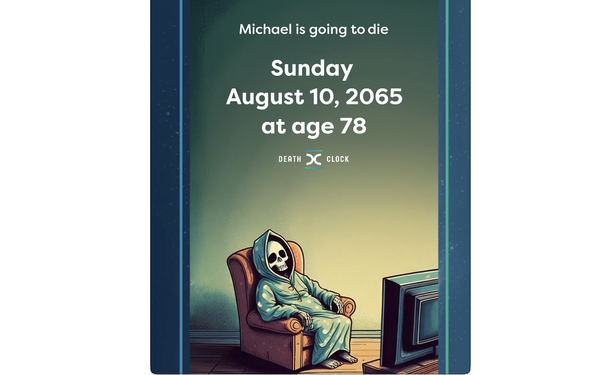
I’m going
to die at 89 years old, most likely of cardiovascular disease, followed by the risk of cancer or sleep disorders.
So says the Death Clock, a year-old app whose intentionally provocative name
is designed to “shake people up,” Founder/CEO Brent Franson tells Pharma & Health Insider. He says the app plays in a “new category: an AI health concierge that
predicts when you are going to die and helps you live longer.”
By taking active behavioral steps to improve my health -- like exercising more, perhaps -- I could live to be 91, the Death
Clock tells me.
If those two numbers shake me up enough, I can submit blood work results to the Death Clock for even more accurate predictions == and take out an annual subscription (average
cost $100) to get behavioral recommendations and track progress towards extending my life for
advertisement
advertisement
“The reality of life is that we all die,” Franson says. “We can’t change
that. The question is when. Every day we make decisions that will either extend the length of our lives or shorten them.”
The free info I received is based on the results of 29
questions, including “How often do you include fruits and veggies in your meals?,” “How often do you eat processed foods like fast food, canned goods, or frozen meals?”
“and “How often do you get at least 7 hours of sleep?”
Then I was given a “save the date” card for sharing, which included graphics of the “grim
reaper” along with my day of reckoning.
With little proactive promotion besides media interviews and social media, the Death Clock has earned “well over a million downloads and
tens of thousands of paying customers,” Franson says.
When Death Clock was introduced, he recalls, “we wanted to look at the usage data to see if people were answering the
questions and what they thought of the predictions. We thought we would just post it to the app store, get a little bit of data, take it down, keep working on the data, and then post it back.
“We had expected to take it up for a test flight,” he explains, but the app “quickly went viral and we’ve been having to build the plane as it’s flying.”
Franson says the app is now 95% complete and “I think we’ll be 100% of version one probably in mid-January.”
For the former “data nerd” and CEO of Euclid
Analytics, which he sold to WeWork five years ago, the Death Clock fulfills a move into “devoting my life and professional capacity to helping people be healthy, prevent disease and fill this
massive gap in healthcare that’s led to epidemics, obesity, diabetes and heart disease.”
He further notes, “We’re not actually a doctor, but we use this analogy because
the number-one factor that determines how long you’re going to live is household income. The top 1% live 15 years longer than the bottom 1%, And the 99th percentile live longer than
the 98th percentile, all the way down.”
While the reasons for this inequity are “complicated and multifactorial, the number one reason is access to better healthcare,"
he adds. "At a certain level of wealth, people opt out of our healthcare system and pay a private doctor to give them good personalized preventative health that’s ideal for preventing disease
instead of getting it and treating it. But there aren’t enough docs nor enough money for that. That system doesn’t scale for everybody.”
Death Clock subscribers get a
”longevity report -- a very comprehensive snapshot of your health” developed in conjunction with a clinical board consisting of “half a dozen leading doctors,” Franson
says.
This report, he claims, is “better than what a private doctor would do for you.” In fact, he relates, “I was on a plan with my private doctor and then he read my
longevity report and said, ‘I agree with this more.’ And we’re [now using]the longevity report.”
So, in this season of countdown clocks -- including the Times Square
ball heralding midnight on New Year’s Eve, and the Doomsday Clock likely to move ever closer to its metaphorical midnight hour of impending global catastrophe -- I’m making a New
Year’s resolution to take heed of my own midnight hour. Ninety-one, here I come!