Citing the First
Amendment, NewsGuard, which rates news sites for reliability, is battling the Federal Trade Commission over its demand for a trove of confidential material -- including clients' identities.
The organization argues in a petition to the FTC that its "civil investigative demand," comparable to a
subpoena, "should be quashed in its entirety because it constitutes unconstitutional retaliation against NewsGuard for its protected First Amendment activities."
"NewsGuard’s activities -- including its reliability ratings and its other journalistic endeavors -- rest at the core of the First Amendment," the company writes.
Court TV founder Steven Brill and Wall Street Journal former publisher Gordon Crovitz launched NewsGuard in 2018 to help people spot fake news online. At launch, the company
was backed by investors led by Publicis Groupe.
advertisement
advertisement
The organization says its reliability ratings are produced by analysts who use "apolitical journalistic criteria and
a transparent process."
The FTC initially served NewsGuard with the civil investigative demand in May, according to the petition. Since then, NewsGuard has provided some
information to the agency, and also attempted to negotiate with its staff to narrow the scope of the subpoena, the company writes.
NewsGuard says that instead of cutting back
its demands, the FTC reiterated some of the "most burdensome" ones. On January 15, agency personnel sent NewsGuard a letter that repeated calls for NewsGuard to disclose the identities of all
customers, communications with those customers, and documents relating to its methodology, the company writes.
NewsGuard alleges that the FTC's demand for information amounts
to retaliation for speech protected by the First Amendment, arguing that FTC Chair Andrew Ferguson "has long been a vocal critic of NewsGuard," and has "promoted an ideologically motivated effort
to censor and otherwise discriminate against NewsGuard based on the content of its journalism."
The company notes that Ferguson tweeted in November 2024 that NewsGuard “led collusive ad-boycotts -- possibly in violation of our antitrust laws -- to censor
the speech of conservative and independent media in the United States.”
NewsGuard also points out that Ferguson stated in 2024 that NewsGuard “seems to give a free pass" to major left-leaning outlets.
That claim "was factually incorrect," NewsGuard says.
"Although biased ratings would still be protected by the First Amendment, then-Commissioner Ferguson’s statement was
factually incorrect: Many major left-leaning outlets receive lower scores from NewsGuard than comparable right-leaning outlets," the company writes. "For example, Fox News scores higher than MSNBC,
the conservative Washington Examiner outscores the liberal Daily Beast, and the conservative Daily Caller outscores the liberal Daily Kos."
NewsGuard notes in its petition that
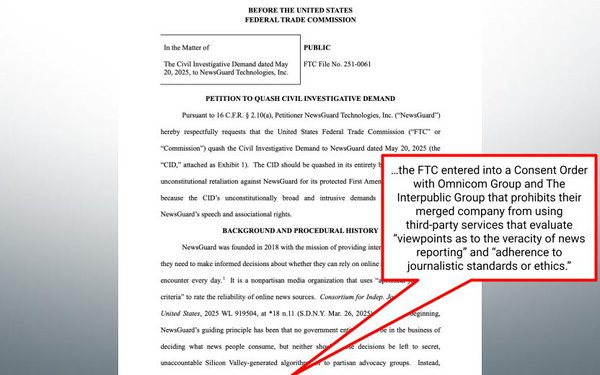
the FTC's order approving Omincom's merger with Interpublic Group "effectively prohibits Omnicom from using NewsGuard’s services."
That order forbids Omnicom from considering media companies' "political or ideological
viewpoints" -- including "viewpoints as to the veracity of news reporting" when purchasing media, except at clients' direction. The FTC specifically restricted Omnicom from directing ad buys based on
media companies' "adherence to journalistic standards or ethics established or set by a third party."
While the restrictions allow Omnicom consider media companies'
content at a client's request, the order prohibits the holding company from using blacklists, whitelists or "other means of differentiating between media publishers," unless those lists were
"developed at the express direction of a particular client."
The FTC's "use of its coercive powers to prevent Omnicom from doing business with NewsGuard as a means of punishing
NewsGuard for its First Amendment activity is unconstitutional on its own terms ... and when viewed together with the FTC’s [civil investigative demand], leaves no doubt that the FTC has
embarked on an unconstitutional campaign of retaliation against NewsGuard," the organization writes.
NewsGuard isn't the only group to oppose the FTC's demand for information
regarding online content. The agency has also attempted to subpoena extensive information from the watchdog Media Matters for America, which published a report about neo-Nazi content on the social
platform X.
Last year, Media Matters sued the FTC and obtained an injunction blocking the agency from pursuing its demand.
The FTC has appealed that order, arguing that it's investigating a potential conspiracy to withhold online advertising "from certain disfavored media."