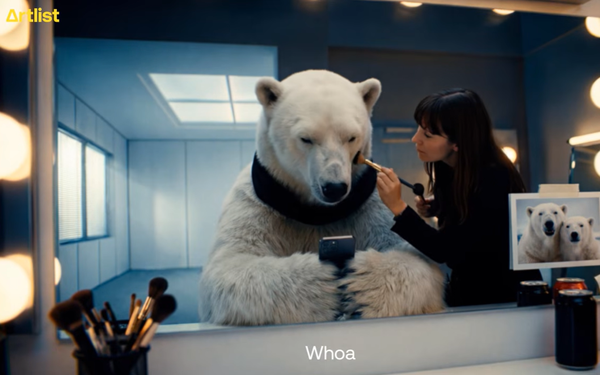
Artlist.io, an AI platform for video creation, produced a Super
Bowl spot in days, pitching the idea of creating faster and cheaper "without limits."
The 30-second ad parodies some of the Big
Game ads from 2026 currently airing, including Fanatics, Bud Light, Budweiser, Instacart, and Pepsi. The purpose is to suggest that production value, creativity and speed are doable — for
significantly less in time and money.
Artlist's AI-generated ad price tag? It was less than $5,000 to create.
“The Super Bowl has long been one of the most exclusive stages in
advertising, defined by big budgets and long production cycles. By using Artlist’s AI tools, our in-house team was able to go from idea to broadcast-ready spots in a matter of three days.
That’s important because it shows how AI is lowering the barrier to entry for high-quality commercial production, giving more creators and brands the ability to move fast, test ideas, and
compete on stages that were previously out of reach. This is what the democratization of advertising actually looks like in practice,” Shahar Aizenberg, Artlist CMO, told Out to
Launch.
advertisement
advertisement
In addition, the company is announcing a subscriber-only creative contest offering a $60,000 prize to those who create their own commercial for the big game. “This
ad is a statement to the industry,” added Aizenberg.
This year, Svenda Vodka and Hims & Hers also used AI as part of their SB ad creation, augmented by a human touch.
AI's
virtues are noted, but also has its critics.
“Anyone can prompt a hundred variations, but it takes a trained creative eye to spot the one frame that aligns with the brand’s soul.
It’s the difference between a generic tech demo and Microsoft’s "Watch Me" emotional resonance,” Vuk Bojovic, director of new business and communications at Elmwood, a brand
design consultancy, told OTL.
“The differentiator in 2026 is craft. AI gives us the raw material, but the high stakes of the Big Game demand the polish of human-led
post-production — editing, compositing and refining. Ultimately, great work relies on discernment: knowing what to pursue, what to enhance, and crucially, what to kill. The tool provides the
"what," but as directors, we provide the "why" that turns a digital output into a cultural moment.”