I originally planned this column for Monday, the day
before Nielsen normally publishes its monthly Gauge data, but on Friday it confirmed it is delaying the March edition another week due to a recalibration.
When Nielsen
launched it as a monthly visualization tracking the share of streaming vs. broadcast and cable TV, The Gauge quickly became the standard for following the evolution of television, and the shift in
distribution technology fueling it.
Turns out Nielsen was measuring it wrong.
As part of a series methodological changes Nielsen has been working on to correct it, it shifted to a new
way of calibrating the media universe estimates it uses to measure viewing.
Instead of estimating the size and scope of the media universe in-house, as it has done for its century-plus
existence, Nielsen for the first time began using estimates from an independent, third-party research service -- the Advertising Research Foundation's DASH data -- which more or less has become the
industry standard for that.
advertisement
advertisement
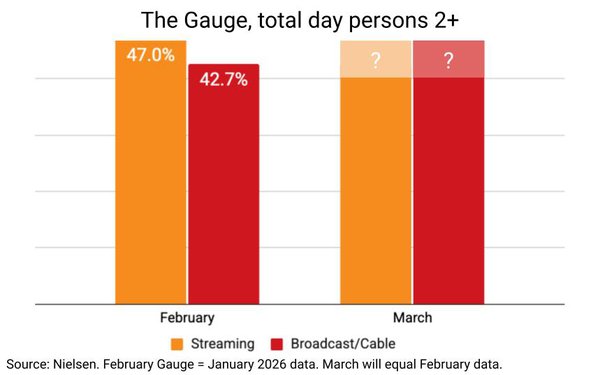
The March edition of The Gauge will publish the first full-month -- February -- of Nielsen data recalibrated on the DASH universe.
The problem -- and part
of the reason for March Gauge's delay -- is that based on what DASH has estimated to date, Nielsen will have to correct the audience shares it's been reporting to date, possibly flipping the dominance
of streaming vs. broadcast and cable.
As of the most recent Gauge (February edition representing data for the month of January), streaming had a 47% share of viewing vs. broadcast and cable's
42.7% share.
"Those two numbers are literally going to inverse," says one knowledgeable Nielsen follower, adding, "When Brian Fuhrer publishes the next Gauge, I don't know what headline
he will try to spin to say, 'oopsie'."
Fuhrer is the long-time Nielsen exec who presents The Gauge, often with an accompanying video commenting on the highlights of the latest edition. He
used to host those videos monthly, but almost always does them when something meaningful happens, as he did in May 2024 when Nielsen introduced a "Distributor" version of The Gauge (see
below).
I don't see how Fuhrer could not host one accompanying the March Gauge, and if he does, it would likely be one that -- in the parlance of industry speak -- sets a new Nielsen
record.
We won't know the precise magnitude of the recalibration will have on the magnitude of The Gauge's share estimates until March 24, but at presstime, even Nielsen insiders acknowledged
it will show a "lift" for broadcast and cable, if not an absolute inversion vis a vis streaming.
Whatever the correction -- Nielsen insiders prefer to call it "methodological innovation" --
ultimately is, they say the long-term trend toward streaming will continue and it will be in a dominant position soon, if not already.
But The Gauge is the broad strokes, and just the first
public view of Nielsen's newly recalibrated data, which includes a complex set of adjustments -- mostly modeling -- that are wreaking havoc on the pre-upfront planning process, because buyers and
sellers still don't know how to calculate share estimates for planning and buying in the upfront.
At presstime, Nielsen had not changed its calendar for releasing so-called "impact data"
showing clients what its estimates look like before and after all the changes: 10-months of impact data by the end of this March; and 12 months by mid-April. Just in time for the upfront pitch season
to begin.
Nielsen has also informed clients it will release six additional months of impact data in June.
That said, it continues to make modeling adjustments and changes as part of
its methodological innovation that could impact the impact data.
In any case, clients will have both the spring and the summer to process the recalibrated Nielsen data, because none of it will
actually be implemented as currency until the start of the next season in September.
That's the currency upfront deals will be posted on.
The problem for planners and buyers and
sellers is they may not be the same as the impact data they will be basing their upfront buying estimates on.
Stay tuned.