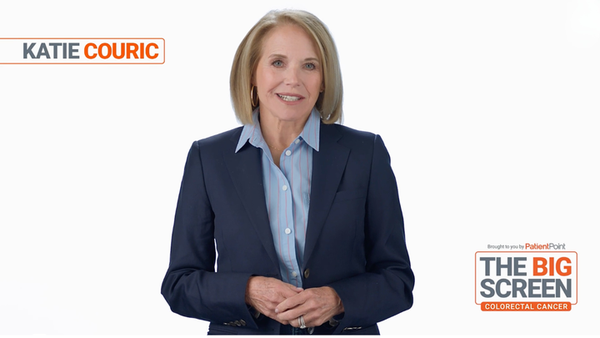
“These days, we spend so much time looking at
screens,” says Katie Couric in a new two-minute-plus video. “Our phones, our TVs, our tablets. But if you’re seeing me right
now, you must be waiting for your doctor.”
Then, in the spot running on 145,000 PatientPoint screens in 30,000 healthcare locations nationwide, the iconic broadcast journalist tells how
“The Big Screen” for colorectal cancer is the “one screening that can truly save your life.”
Couric has been passionate about colon cancer screenings since her husband
Jay died of the disease in 1998. Two years later, she courageously underwent a live colonoscopy on NBC’s “Today,” and most recently has been involved in campaigns from the Colorectal Cancer Alliance and Cologuard.
advertisement
advertisement
The new campaign, developed by PatientPoint in partnership with Katie Couric Media, has
launched in conjunction with Colorectal Cancer Awareness Month and is set to run through September.
In addition to the waiting room video, there’s a shorter version (0:49) that
“allows the campaign to extend beyond physician offices,” PatientPoint CMO Kyle Barich tells Marketing Daily. It’s been posted on social media like LinkedIn, Facebook,
Instagram and TikTok.
“The campaign is focused on driving both awareness and action,” Barich says. “The goal is to encourage more people to start conversations with
their doctors about colorectal cancer screening and to empower those who are eligible to follow through with getting a screening.”
Impact will be evaluated by working with
healthcare providers (HCPs) “to monitor screening activity during the first six months that the campaign is running.”
Those HCPs, all of whom have PatientPoint screens in their
waiting rooms, include primary care physicians and such specialties as gastroenterology, cardiology, dermatology and OB/GYN, Barich notes.
In the main video, Couric points out that
Jay was just 42 when he died and that “now, even more people under 50 are being diagnosed with this disease.”
“Look around this waiting room. Only two out of three people who
should be getting screened actually are. Don't be the one who doesn't. You're here. You showed up. Now have the conversation. Ask your doctor about getting screened for colorectal cancer.”
Barich adds that “tracking increases in patient inquiries and completed screenings will help underscore the role that point-of-care messaging can play in prompting meaningful
health actions.”