Year-over-year digital ad growth has fallen to
low single digits and is projected to dip below 3% by 2029, the slowest pace in the past 18 years, according to Borrell Associates.
The 2026 Annual Benchmarking Report on Local Digital Media
from Borrell Associates released today analyzes local digital advertising trends, including revenue benchmarks, market-level forecasts, and detailed data on business growth across U.S. regions.
The finding is based on Borrell’s proprietary data from more than 9,000 local media operations and advertising estimates across 513 U.S. markets shows digital advertising has entered a
"slow-growth era, triggering an intense battle for market share among media companies."
This is not an ordinary decline. Digital has become normalized, according to Gordon Borrell, founder of
Borrell Associates.
advertisement
advertisement
"Digital is mature," he said. "Growth won't come easily now; only companies that take market share from rivals will succeed."
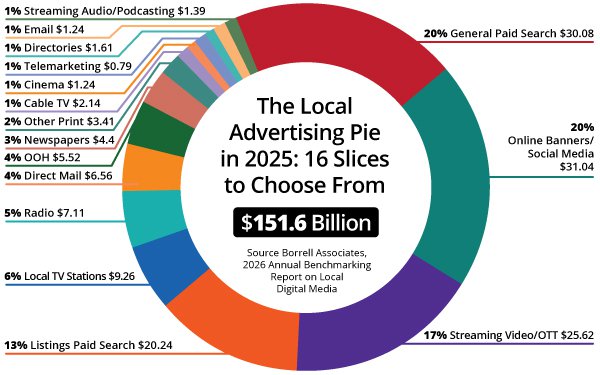
The data shows that digital now
accounts for 72% of local ad spend, yet no one format dominates.
Still unknown is what role AI will play. Paid-search advertising may be flatlining, but advertising placement on AI platforms
has already risen. It is likely to be more of a replacement for keyword budgets than a supplement to them, according to the report.
This year, 84% of local digital advertising still goes out
of the market. This means either engaging customers who are not currently ready to purchase, focusing on brand building, or the discontinuation of a marketed product.
Ad budgets are spent
mostly with providers such as Google, Meta and national listings sites such as Cars.com, Zillow, Monster, Autotrader, and Angi/HomeAdvisor.
For local advertising, display, social, and video
have overtaken search advertising. This signals a major shift in behavior for advertisers and consumers.
Digital advertising sold by local media companies reached $17.8 billion in 2025,
becoming the largest single segment of “obtainable” dollars -- larger than local TV and radio advertising combined.
There are performance gaps in strategies. A small group of media
companies hold three to more than four times the share of their in-market competitors, demonstrating that success is achievable but not widespread as the advertising base evolves.