Of all the parts of the advertising business I've covered during my
career, I consider consumer research the most interesting, because it is insights about what people feel, think and do that underpins every part of successful advertising campaigns -- from strategy
through ideation, targeting, execution and ultimately, measuring results.
How advertisers and agencies get at it may vary, but research -- whether it is warm and fuzzy focus groups or massive
quantitative studies -- is where it all starts, and ends.
Not surprisingly, I'm also fascinated by the rapid embrace of synthetic consumer research generated by artificial intelligence (AI),
and wonder if it's actually better, worse, or just different.
So when Brian McHale, founder and CEO of Cincinnati-based Brandience, announced his agency's new, proprietary AI-powered
"Synthetic Market Research & Testing" system, I asked him that question.
advertisement
advertisement
You can listen to his response in the video clip from our interview above, but I think McHale is utilizing it in
the right way -- not taking synthetic consumer research as gospel, but as another tool in an ad agency's insights chest.
Appropriately, Brandience has not onboarded the SMRT system to its rank
and file, and at least for the time being, is using it exclusively within its insights group -- which works with the other departments to develop and execute their strategies.
At least for
now, because sophisticated human judgement still is needed to determine the value, veracity and application of what AI generates about, well, humans.
On the upside, synthetic research is fast,
cheap, and potentially powerful to execute.
On the downside, it is prone to hallucination, erroneous findings and distortions of reality.
On that latter point, I'm not sure anyone
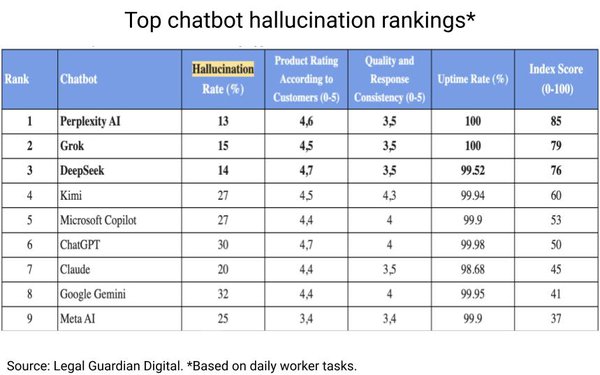
really knows -- or may ever actually know -- how much AI distorts reality, but about the same time McHale was briefing me on SMRT, I received an analysis from Legal Guardian Digital ranking top AI
chatbots based on their propensity to hallucinate.
That said, some of the greatest ad campaigns ever created likely were generated by some humans who also were hallucinating. I don't have any
actually stats on that, but I did just prompt Gemini about that and it estimated 0%, but also noted that the "Mad Men" era of ad
creativity was known for its "liquid lunches," and "fever dream" creative ideation, so take that for what you will.
You can read the full study here, but the study found the
percentage of hallucinations ranged from 13% on Perplexity to 32% on Gemini outputs.
To date, I have not seen any similar ranking of ad industry synthetic research or so-called "simulation"
panels, but I'm going to guess they have similar latitudes and therefore should be applied and evaluated with similar levels of skepticism, human fact-checking and judgement.
That's exactly
how McHale describes SMRT's integration at Brandience to date.
While the system has been in development for some time, SMRT is just now being rolled out publicly, so I also asked McHale if he
could provide some examples of insight outputs generated to date, all of them anonymized to protect the innocent, as well as client confidentiality. Here they are:
Excerpt 1
(service category):
- Theme: Convenience Is a Gatekeeper, Not a Bonus
- Across participants, ease of
access functions as a threshold requirement rather than a differentiator. When a service fits into everyday life, it earns consideration; when it does not, it is removed from the set entirely.
Respondents describe time scarcity, unpredictable schedules, and family responsibilities as overriding realities that shape decision-making before perceived quality is even evaluated.
Excerpt 2 (service category):
- Emotional and equity-oriented insight
- Several respondents describe an added layer of
emotional work during interactions, needing to prepare, self-advocate, or remain vigilant in order to feel taken seriously. These experiences heighten sensitivity to tone, respect, and perceived
judgment, shaping preferences as much as functional outcomes. Trust is influenced not only by performance, but by whether individuals feel acknowledged and understood.
Excerpt 3 (consumer category):
- Decision behavior pattern
- Brand preference is largely absent at the moment of
choice. Instead, availability and immediacy dominate decision-making. When an option is present at the point of need, it is considered; when it is not, it functionally does not exist. Consideration is
driven more by situational relevance than by preexisting brand meaning.
Excerpt 4 (consumer category):
- Trust substitution
insight
- In the absence of strong brand differentiation, decision-makers often transfer trust to the environment in which the product appears. Confidence in the retail
or distribution context substitutes for confidence in the brand itself, particularly in categories that receive low attention and infrequent deliberation.