gro
"Half of shelf equity is reset to zero," reads the
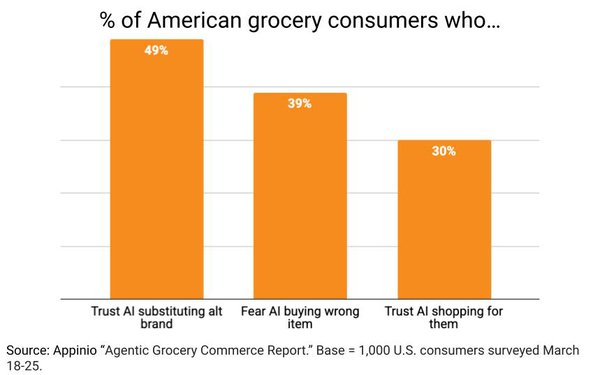
nightmarish headline of a press release prompting today's post about Americans' agentic shopping plans. The release was about a new study of grocery shoppers, which found that 49% of them would trust an AI substituting an alternative brand for a
consumer's preferred brand.
The study found a "blend of consumer" needs would drive that agentic brand-switching behavior, but the No. 1 reason stated by 54% of the respondents was "finding a
better-value alternative."
The study goes on to note that a sizable share (39%) of American grocery consumers fear AI would buy the wrong item for them, while 30% trust AI to shop for
them.
Of course, no one knows what consumers will actually do until agentic grocery shopping actually scales. But I suspect that the projection is accurate, and may actually understate how
many people actually embrace agentic shopping, because in the end, I believe most consumers gravitate to technology that provides convenience, and ease-of-use, more than fear getting the wrong
thing.
advertisement
advertisement
Time will tell, but my main reason for flagging this study is its conclusion about grocery-shelf equity, which I think is completely wrong.
If agentic shopping scales, shelf
equity will not be reset, it will just transfer from one shopping entity (a consumer) to another (an agent).
In other words, grocery -- and other retail brands too -- will need to figure out
how to build equity with agents.
I know the concept of agent brand equity is a new one -- and maybe an antithetical one -- for many marketers and agencies, but some have already begun building
models to measuring and optimizing it. It's what Omnicom agency MRM has been working on within its ARM (AI Relationship Marketing) practice.
In other words, think of it as the new CRM, or
consumer loyalty, or brand equity, or whatever old school framework you've been using to understanding the extrinsic value consumers place on a brand -- not just for groceries, or retail, but for any
non-commoditized brand where goodwill value still matters.
The only thing you have to change to embrace the concept is substituting the word "agent" for "consumer," because the next generation
of consumer shopping agents will effectively be proxies for consumer purchasing decisions, including the amount of value they attribute to the brand vs. its competitors.