The massive volume of water required to
keep data centers running has become an environmental and regulatory challenge, as use of artificial intelligence (AI) and cloud services for advertising and business accelerates.
Microsoft says it has created a new "closed-loop cooling system" that circulates water and keeps it in motion to cool its data centers rather than drawing on millions of gallons from local
sources.
That is how its newest data centers were built. If successful, the system will remove one of the largest obstacles in building these massive buildings, and will likely make many
advertisers much more satisfied when conducting business.
In the meantime, Microsoft wants to make the case that its AI-fueled data-center expansion does not come with soaring water use.
Microsoft acknowledges that local communities also want to better understand how these data centers affects resources -- specifically water -- and it wants to replenish more
water than it uses.
advertisement
advertisement
Across its owned datacenters, Microsoft has made a commitment to a 40% improvement in data-center water use by 2030.
As of 2025, Microsoft estimated it
had reduced water use by 25%. That reduction means the company is well on its way to its original goal.
This progress reflects the impact of its continued investments in water-efficient
cooling technologies, operational improvements and responsible water-management practices.
A Gallup poll from May 2026 revealed that water scarcity ranks as the top resource
concern among Americans regarding data-center-development, with seven out of 10 citizens opposing local expansion.
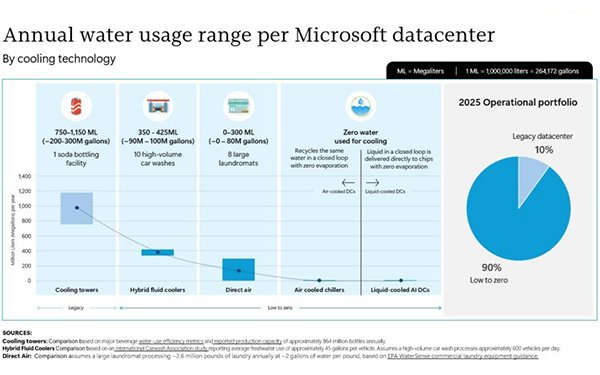
Older data-center cooling systems typically remove heat by evaporating water
year-round. Hybrid fluid coolers evaporates water for cooling during hot summer conditions and switch to dry mode when ambient temperatures cool down, and there are also direct air coolers and
air-cooled systems.
Liquid-cooled AI systems are now available that use closed-loop, direct-to-chip cooling to provide precise temperature controls, removing heat efficiently with zero water
evaporation.
Microsoft has three data centers in Washington, Singapore and Texas that use this advanced system, leveraging 74%, 99% and 79% recycled, reused or non-potable water sources,
respectively.
Rainwater harvesting systems are now in place at select datacenters in the Netherlands, Sweden and Ireland, with additional installations planned in Canada, the United Kingdom,
Finland, Italy, South Africa and Austria.
Microsoft plans to implement onsite water treatment systems as needed that enable facilities to recycle water multiple times for cooling operations.
These systems produce purified water suitable for reuse within cooling systems, reducing dependence on utility water supplies.
Through its zero-water cooling designs optimized for AI
workloads, water reuse initiatives for on and off the Microsoft campuses and community programs, Microsoft says it is working toward a future where digital growth and responsible water management go
hand in hand.
Microsoft also is exploring zonal cooling architectures that more
precisely align cooling approaches with the needs of different hardware types, improving efficiency while supporting a diverse mix of AI and traditional workloads.