Of all the narratives circulating at this year's Cannes Lions
festival, the most constant one was that for all it's rapid advances, AI will not replace human creativity. It came in stark contrast to the 2025 festival's dystopian AI-replacing-human-creativity
vibe, but it makes sense given the amount of "slop" AI has generated in the past 12 months.
But the real question Cannes-watchers should be asking themselves isn't whether AI is the slop
problem, or the way humans have been using it.
And while there were plenty of examples of creatives using AI to enable executions humans wouldn't otherwise be capable of generating on their
own -- take Rich Silverstein's AI-imagined "13 Days The Musical" -- the
consensus was that people are using AI for the wrong end.
advertisement
advertisement
That was confirmed by the Lions' editorial team's wrap-up this morning, during which the content team shared some of the findings form
their "closed door," off-the-record conversations and polling with C-suite attendees.
Asked whether they planned to use AI to drive "efficiency" or "revenue growth," 57% cited efficiency,
while 43% said growth.
"We just finished some research for the WFA exactly about this," Contagious Editorial Director Alex Jenkins chimed in, adding, "What they found was that only about a
third of marketers were using AI for creative effectiveness. The majority was an efficiency play."
"This tension between efficiency and effectiveness is the defining issue of this Cannes,"
concurred Lions Intelligence Chief Content Officer David Tiltman, adding, "That was the focus of conversation" in the closed door sessions.
Tiltman also identified another subtext theme that
relates to the creative effectiveness vs. efficiency debate, which he described as "the two-audience problem."
He cited the Jellyfish sponsored study showing how an AI -- Google's Gemini --
rated 480 Lions-winning campaigns from previous years. That study, which we reported on Monday, revealed there was "zero correlation" between how AIs and
human judges rated those campaigns.
"The work we are seeing here -- the amazing stuff we're seeing engaging humans -- has no impact on the [AI] models," Tiltman summed up, adding, "This is the
two-audience problem.
"We need to be thinking about how adapt creativity to [the AI] audience, as well as the human audience. It sounds scary, but actually it's doable. It just means that
everything we do has to be machine-readable. It means we have to think about the context."
He characterized the two-audience problem as "a really big, emerging space that is going to affect
the way we develop campaigns, creative platforms, systems, everything. It's fundamental."
As if that wasn't scary enough, Contagious' Jenkins chimed in with an even more horrifying example
that we should all be thinking about:
"There's some new leaked documents from Russia's social design agency showing that Russian propaganda is now moving ot creating Wikipedia clones in order
to influence AI chatbots," he shared, adding, "They're on the two-audience problem already."
Weaponization aside, I think the two insights -- both the two-audience problem, as well as the
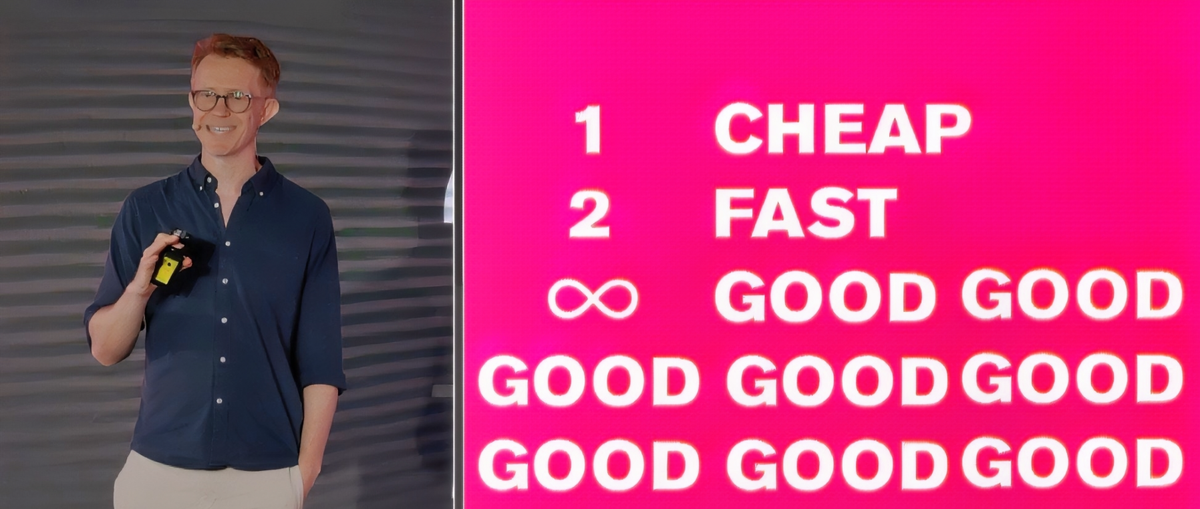
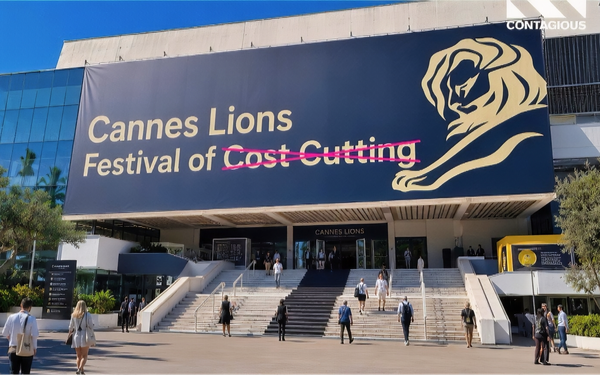
polling that marketers are using AI for efficiency vs. effectiveness -- could best be summed up by a slide and an image Jenkins showed during a Lions presentation earlier in the week. It evokes the
classic "good, fast, cheap" project management triangle paradox, but with an AI-generated twist.
The graphic below, as well as the rendered image of the Palais above, were part of Jenkins'
presentation which can be downloaded via the code at the bottom of this article.