Much of the first day main-stage discussions at this
year's Cannes Lions Festival of Creativity focused on the human and artificial intelligence (AI) collaboration to come up with bigger ideas for better advertising. But one of the most fascinating
sessions was a presentation of research analyzing how AI rated the creativity of award-winning Lions ads vs. how the human judges rated them.
The top line: there is zero correlation between
the two.
"There are differences between models and human minds when it comes to basic brand awareness, so you would expect this to be," explained Jellyfish Vice President of-Strategy Tom
Roach, one of the presenters of the research, which took Cannes award-winning campaigns from the past and ran them through Google's Gemini to see how they ranked.
If there was one
methodological flaw in the analysis, it was that Gemini likely had a revisionist view of those winning campaigns, whereas the human judges were evaluating them as part of a real-time judging process
alongside other contenders.
advertisement
advertisement
That said, the findings should be illuminating for ad industry pros who are trying to come to grips with how to integrate AI thinking into the creative, planning
and media decisioning process.
"We're beginning to anthropomorphize the models in a way that I don't think is helpful when it comes to creativity," Roach cautioned, adding: "And so we, because
we use chatbots because we're thinking and a lot of the way these things are positioned, is as kind of surrogate humans. We don't think from this research, the models will actually be creative in the
same way that human minds do."
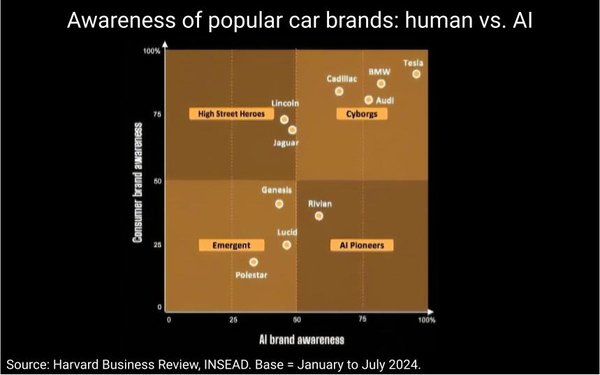
To illustrate the differences in the way human and AI "brains" process things, Roach presented data showing how automotive brand awareness plots on an X (AI) and
Y (human) axis to make a visual data point.
But things got even more interesting when he turned the presentation over to David Dubois, a professor at French business school INSEAD, to show
findings of the man vs. machine rankings for 480 award-winning campaigns.
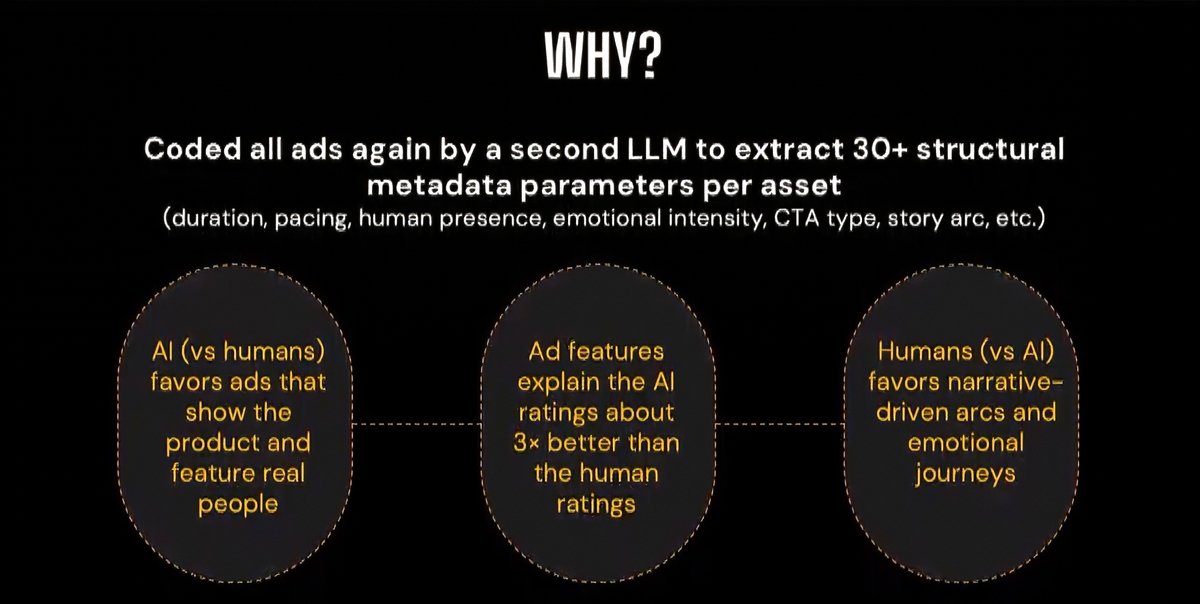
"There is zero correlation between how humans view an ad, and how AI view," he revealed, adding that when the analysts
looked at the differences in the human and machine preferences that found some explicit factors (see below), including the fact that AI prefers ads that show a product and feature real people, while
humans prefer ads with narrative arcs and emotional journeys.
There were more granular details of the differences presented, but the bottom line for the ad industry is that it is now creating
for two distinct audiences, including one that that requiring advertising is both machine-readable and understands its metadata parameters.