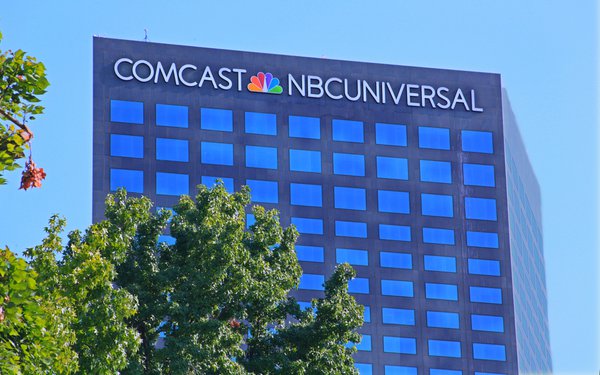
Big, "vertical" and synergistic-seeking media mergers are
officially no longer a thing now that Comcast Corp. has decided to break the company apart. Again.
Following on its Versant Media spinoff -- its linear TV cable networks -- Comcast Corp. is
spinning the company into two: Comcast (broadband, fixed-wireless and cable/digital streaming/networks distribution) and NBCUniversal (including movie studios, NBC TV network/stations, Peacock and
cable network Bravo).
Comcast executives say that allowing those businesses to be aggressive in more siloed and defined markets is a better approach going forward.
What’s next?
Initially, analysts are speculating that both Comcast and
NBCUniversal may now be in play.
advertisement
advertisement
For its part, Netflix -- which did not pursue a WBD deal -- could be more interested in an NBCU combination.
On CNBC on Monday, former NBCUniversal
senior executive Ben Silverman believes Netflix is a possibility because the big streamer is more focused on building up more library content, studio operations and streaming platforms -- something it
pursued with the WBD deal.
NBCU also has those strong components.
Silverman also believes that NBCU, right now and on its own, can “scale up Peacock with some acquisitions and
investments,” making it a bigger streaming player.
All of these elements make it a more valuable company.
Initially, Comcast stock rocketed up 17% on news of the Comcast-NBCU
split in the hope of not just growth, but possible mergers with other competitors or companies. Charter Communications also soared nearly 20%.
Still, the immediate reaction of MoffettNathanson
Research media analyst Craig Moffett is that he does not see a Comcast-Charter Communications deal or a NBCUniversal-Netflix deal in the near term.
At the same time, co-anchor/market
news analyst David Faber believes consolidation is most likely to happen over time -- especially for the likes of Comcast and Charter. Right now, that possible combined company would have an
eye-popping $210 billion in debt.
The long-term outlook is another story: “Certainly one can imagine that could be the case [of a Comcast-Charter combination].”
All this
comes amid major realignment in the traditional TV and streaming media content world, with Paramount-Warner Bros. Discovery nearing completion of its merger, and Fox Corp. announcing a deal to buy
streaming distributor giant Roku.
This doesn’t mean that the initial Comcast-NBCU combination, which started up in 2011, failed completely.
For a long time, there were benefits
in synergy between NBCUniversal’s own cable channels and the Comcast cable TV distribution system.
More recently, Comcast Freewheel ad technology gained major digital media benefits
linking up with NBCU’s massive advertising-focused content.
What did fail was that the Comcast Corp. stock price never really moved much in 15 years.
AT&T and Fox Corp. in
separate deals had some of the same experiences.
In 1999, Fox Corp. read the writing on the wall that legacy TV networks were not a growth business, so it sold off half of the traditional
production and cable networks to Walt Disney for $71.3 billion.
And AT&T -- in a similar business to that of Comcast and Charter -- sold off Warner Media after only four years of ownership
to Discovery Inc in 2022 in order to focus -- like Comcast is doing now -- on its core communications businesses.
Buying into wide-scale mergers for diverse media content, distribution
communications/connectively businesses -- if it happens at all -- is viewed with much greater scrutiny.
But now, perhaps those bigger cash-rich, digital-first media companies -- Amazon, Meta
Platforms, Apple, and Alphabet (Google) -- can play around to a small degree with such businesses.