Apologies for getting dark on what should be an
uplifting celebration of America's 250th birthday. But as someone who has been covering its media for nearly a fifth of that time, it has become increasingly darker, especially recently.
Consider some of the stories I covered in the days leading up to Independence Day:
That's quite a lead-in for the next 250 years. Or as Ben Franklin might
have said, "If you can keep it."
America's most recent media history would suggest otherwise, especially as we move into what looks to be an increasingly synthetic future.
Now would be
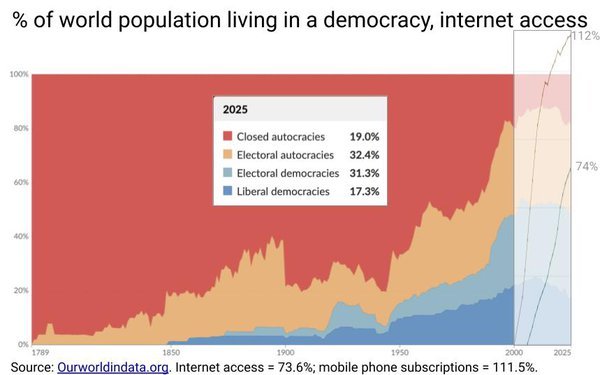
a good place for me to repost the correlation showing the decline of democracies with the rise of digital media.
Read more about that here, but suffice to say it hasn't been heading in a democratic direction.
The gray
shaded area on the right shows the percentage of the world's population with internet access overlayed on a corresponding rise in autocracy.
What's my point and why do I keep repeating it? And why do I keep repeating it to you, ad
industry pros?
It's because advertising underwrites media, including technological innovation determining what kind of information people see, so I believe the ad industry has to take some
responsibility for supporting platforms and content that misinform the republic, as well as the rest of the world we interact with.
When WPP Media President of Business Intelligence Kate
Scott-Dawkins published her mid-year update on the advertising economy, she included a remarkable observation that the acceleration of AI-influenced media is like the California gold rush in that it
has a similar sense of "manifest destiny."
She also pointed out that the
advertising is the industry that is primarily funding it, so I asked her whether advertisers and agencies also have some responsibility for whatever manifests from it. She demurred, but it's a
question I ask of any influential person in the ad business, and so on America's 250th birthday, I'm asking anyone reading this the same question of you.
In the span of a very few years, the
ad industry has gone from championing putting its money where its "brand safety" mouth is in terms of the power of its ad spending to capitulating with a highly politicized government agenda to
constrain the commercial free speech of brands to support responsible media and "de-monetize" the irresponsible kind.
And for what it's worth, they've deprecated other responsible uses of ad
spending, including support for climate change, DEI, and other things vital to the future of our nation, as well as the rest of the world.
But chief among all of these factors is the role
media plays in informing or misinforming the public to make educated decisions.
That's why the United Nations was present in Cannes the other week to sound the alarm that misinformation and
disinformation has emerged as the top "global vulnerability" -- because it doesn't just undermine democracies, but the stability of the entire planet -- and called on the ad industry to support its Global Initiative for Information Integrity. I can't wait to see what wiki clone
Russia's Social Design Agency creates to undermine that.
Lastly, as you ponder what, if any, responsibility you as an advertising pro have in making America's media industry a better place, I
figured this would be a good place for me to run a video from part of a conversation I had with Association of National Advertisers' soon-to-retire President Bob Liodice.
I asked the same
question of him, and this is what he said: