Microsoft has been accused of abusing its
control over the Windows operating system to push its Edge browser.
The deceptive practices include a design technique called "dark patterns," used to manipulate users into making choices they
may not otherwise make.
When Windows forces or manipulates users to use Edge as its default search engine Bing, it directly changes where consumers see ads.
The Browser Choice
Alliance, a coalition of browser developers like Google and Opera, sent an open letter to Microsoft CEO Satya Nadella that accuses the company of anticompetitive practices aimed at forcing users to
choose the Edge browser.
For example, when a user assigns Google Chrome as their browser of choice to launch at the start of the computer booting up, Microsoft Edge also will launch at
the same time in an attempt to get the user to search via Edge rather than Chrome. Some call this anticompetitive behavior.
advertisement
advertisement
In its letter to Nadella, the Browser Choice Alliance points
out that users who are forced into using Edge via “dark patterns” may switch back to Chrome or Firefox immediately. Impressions or accidental clicks generated during these forced
interactions often lead to poor conversion rates and wasted ad spend.
In the letter, The Browser Choice Alliance demands Microsoft end "financial coercion" of original equipment manufacturers
(OEMs), forced software bundling, and the use of dark patterns to override user browser preferences.
Browsers can keep users in an enclosed loop. They serve as the primary gateway to
cloud and AI services like Copilot. Edge tracks user behavior, search data, and system settings. Edge might feed data directly into Microsoft's ad optimization engines. Chrome
does the same for Google.
Competitors argue Microsoft uses dark patterns to make it difficult for users to download and use alternative web browsers, and the alliance claims Microsoft
uses dark patterns to suggest Edge is faster, safer, or essential for Windows security.
"Microsoft leverages its immensely powerful position as the supplier of the ubiquitous
Windows PC operating system, as well as many productivity and other must-have apps, to push users towards its first-party browser, Edge, through tactics that restrict, distort, and subvert user
choice," according to the letter sent to Microsoft CEO Satya Nadella in June.
When Microsoft uses its Windows ecosystem to steer users toward its own browser, it restricts user choice,
undermines web freedom, and unfairly tilts the playing field in its favor and away from fair competition and innovation, according to the alliance.
Mozilla, a member of the Browser
Choice Alliance, asked two leading experts on deceptive design, Dr. Harry Brignull and Cennydd Bowles, to look at how Microsoft treated people who tried to use a different browser on Windows. The
first report, Over The Edge, published two years ago, documented a pattern of design choice.
The second part of the report, Over The Edge 2.0., published on Tuesday, found AI features like Copilot are being used to shape the same
outcomes that the original report identified.
"Microsoft still does not allow users to download, set as the default, or keep using alternative browsers without harmful interference," according
to the summary. "The patterns are documented, and they meet established definitions of coercion, deception, and manipulation."
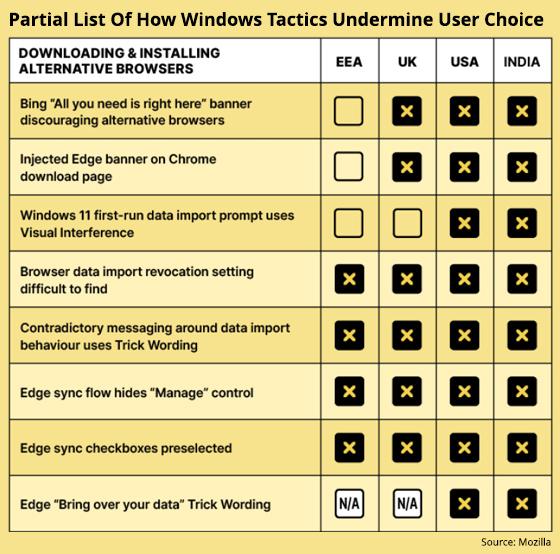
In Europe, however, the Digital Markets Act applies some
relief, according to Mozilla.
Specific issues called out in Mozilla’s blog include:
“The Bing ‘All you need is right here’ panel and its trick wording. The nagging Windows 10 ‘You’re almost done setting up your PC’ journey.” The Copilot data
toggles the default to 'On' in the U.S. and India, by contrast default to 'Off' in the EEA and the UK. Same Windows. Same Edge. Same Copilot. Different design choices, because the law required
them.