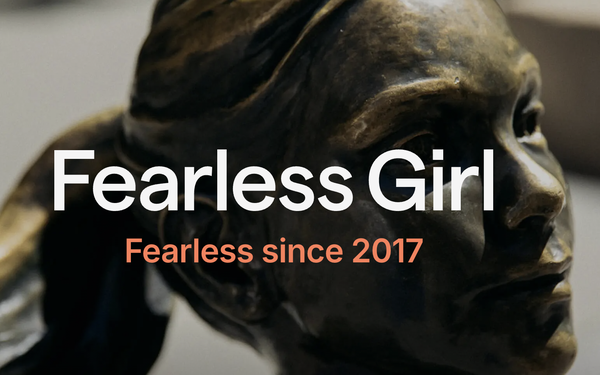
It feels like more than nine years since
State Street planted Fearless Girl, a sculpture of a small-but-sturdy child facing down Wall Street's better-known Charging Bull. (Older readers may remember that a decade ago, brand statements about
advancing the careers of women and minorities were considered brilliant marketing, rather than an invitation for anti-DEI activists to sic the lawyers on you.)
But State Street Investment Management, the fourth-largest asset manager in the world, hasn't forgotten, and may well be a case study in a growing marketing dilemma:
How do you keep a valuable brand asset -- one that will surely survive longer than Donald Trump’s presidency -- alive and well, even if it doesn’t mean what it once did?
The
financial giant’s solution: It's relaunching Fearless Girl, a four-foot bronze statue, as a full-fledged brand, starting with a block party in New York on July 24. The free street festival will
include a DJ, treats, statue merchandise, augmented-reality photo ops -- and a branding update from the event's organizers on what the upcoming campaign will look like.
advertisement
advertisement
The statue was first planted in 2017, installed overnight in a stealth move on the eve of International Women's Day. "She became a cultural flashpoint almost
immediately -- a headline, a viral image, a moment that felt both overdue and electric," the company notes on its Fearless Girl website. "People had strong opinions. But something else happened too,
something quieter and more lasting: People came to stand beside her. And they felt something, and they kept coming back."
Almost 10 years on, people still
do, hence the party and the coming campaign.
The event comes at a different moment than the launch. Given broad pressure from politically conservative
activist investors and looming threats of federal investigations, corporations have retreated. Many will see both irony and hypocrisy. State Street itself quietly dropped its own requirement that
company boards have at least 30% women directors, updating its proxy voting guidelines last March, following similar changes by BlackRock and Vanguard.
Governance changes are mirrored in identity marketing efforts, too. While no reliable statistics exist on the number of brands that have toned down International
Women's Day branding efforts, Pride Month -- equally under attack -- offers a reasonable proxy: Gravity Research found that 39% of companies it tracked scaled back Pride-related engagement last year,
up from 9% the year before.
And women’s representation on boards, a key goal of diversity requirements, has certainly declined since the Trump-era crackdowns, with women’s
representation falling below 30% on Russell 3000 company boards in the first quarter this year, according to an analysis by Equilar and 50/50 Women on Boards.
But plenty of criticism came from the left, too, with people arguing that IWD efforts had become performative or even tokenistic.