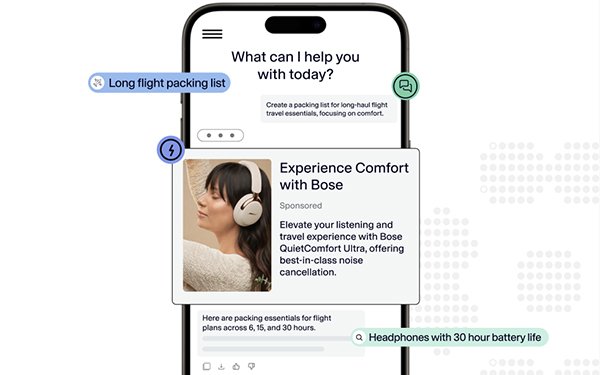
Marketers are beginning to think of AI assistants as an
advertising channel specifically for certain categories such as travel, healthcare and financial services.
AI has been built on the ability to identify intent before it occurs -- not as a
prediction, but as a calculated event. Historically, users entered keywords in search, and matching technology acted as a trigger to serve the ads.
Verve COO Mishel Alon believes
developers at the company developed this option, and he describes it as a native AI ad design that assists brands to reach consumers inside generative AI experiences.
Verve's technology
can understand intent even before a product name or category is entered into the AI search engine -- for example, when someone buys tickets for a basketball game, and then in a few days that same
person may get served a sneaker ad from Adidas.
advertisement
advertisement
The ad does not rely only on that specific search, but other data as well, using searches across the internet on publisher sites that
participate in Verve's ecosystem. The platform does not store information, but triggers the ad based on a variety of data.
The ad serves up similar to the way OpenAI has designed its platform,
supporting companies like Best Buy, Lowe's, and VistaPrint, but not based on their market sector.
The difference between ChatGPT and Verve's "AI Native Ad" is that the latter runs in many
apps, not just in OpenAI's network.
Alon did not provide a list of apps the company works with or advertisers that are using the ad unit inside the apps.
Media buyers today must
acquire the ads as a managed service, Alon says, but this will change. During the next few months, Verve will offer a self-service platform, as well as ads that run programmatically.
"If
someone uses a travel app to make travel plans, they are in a different mindset than when using a general purchase product like ChatGPT," he said. "The likeliness of a brand reaching the perfect
audience declines."
Eventually, general purpose chat apps will offer specialized services, which will be a challenge for Verve in the long term.
Alon mentioned OpenEvidence, a medical
LLM search engine used by healthcare professionals, that now requires authentication with a unique identifier to gain access.
"I'm expecting general purchase engines to focus on verticals," he
said.
The launch of AI Native Ad builds on Verve's AI strategy, and follows the introduction of "Verve Intelligence," which uses large language models (LLMs) to help advertisers better predict
consumer intent. With the AI native ad solution that launched today, Verve extends a strategy from insight to activation, giving advertisers a way to reach consumers directly in generative AI
environments
Verve collects data from consumers directly through its proprietary SDKs, and partners with publishers to aggregate signals from across the web. Those signals extends its
technology's view of intent and behavior.
The company also runs a data exchange model that enables publishers to share data in return for insights.