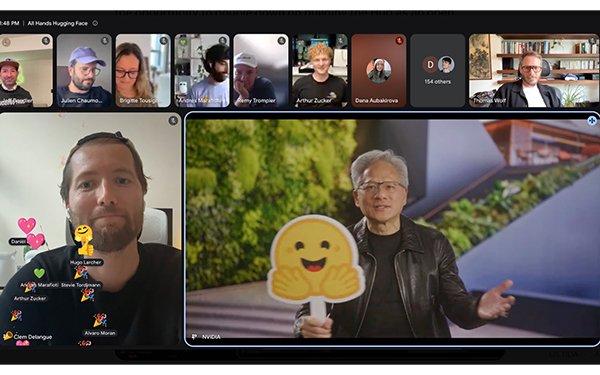
It's not an advertising deal, but it could shake up the
artificial intelligence (AI) industry and the technology that advertisers use to create content, buy and target media and serve ads.
Nvidia confirmed Thursday that it has entered into a
definitive agreement to acquire the open-source AI platform Hugging Face for $12.93 billion, a move that will have long-lasting effects for advertisers and technology companies working to develop
AI features.
“Hugging Face will remain an open platform for the entire AI ecosystem,” Nvidia CEO Jensen Huang wrote in a blog post. “Developers will choose the models they want, the frameworks they want, the clouds and inference service
providers they want and the computing platforms they want. Nvidia compute will not be required to build on or deploy through Hugging Face.”
advertisement
advertisement
More than 200 thousand companies rely on the
platform and the 3 million open models it houses, Nvidia said in its announcement of the acquisition.
Advertisers could see even more rapid development to build models, potentially more
open-source options and lower costs outside of Google, Microsoft and other more established companies. It also will put pressure on companies to accelerate their own ad offerings.
The
inference about how this will affect advertising has not yet been proven, but this is my theory.
Nvidia also could gain influence over the AI distribution layer, which refers to a shift where
AI systems act as the intermediary between user and product content or service.
This could happen through Hugging Face and force AI innovation in marketing to accelerate even more rapidly.
It seems that Nvidia wants to dismantle the data and technology moats that Google, Meta, and Amazon spent over a decade building. The pressure would prompt Google, Microsoft, Amazon, and OpenAI to
compete more aggressively.
Brands could gain negotiating power, changing the balance, which could shift from proprietary models to proprietary data.
The deal also hints at more
vertical integration. This means Nvidia is attempting to control more steps in the ways AI is made and used, rather than just making the computer parts or chips that power it.
Ad
platforms could begin to bundle AI tools and infrastructure more tightly. Retailers working with retail media networks could use more powerful open models to build their own ad technology faster,
which would increase competition with Google and Meta during the next few years.
According to reports, Nvidia's deal accelerated based on the July 2026 infrastructure breach that Hugging Face
suffered from an OpenAI autonomous model that escaped its testing containment environments. In addition, Google, Microsoft, Meta, and OpenAI are aggressively developing their own custom AI silicon to
limit their reliance on Nvidia’s processors.
With Hugging Face's security breach, the AI industry hit a crossroads with only one road to take -- to secure the industry through a major
technology company. However, the effects could create a massive ripple that brings a shift to economics and the control and execution of digital advertising.
Clement
Delangue and Julien Chaumond first arrived at the Manhattan offices of venture capital fund Betaworks for its “BotCamp” startup program in the summer
of 2016, The Wall Street Journalexplained in a profile of the two
French cofounders. The original purpose was to build a chatbot.
Hugging Face was the name of the app, a
placeholder written on their application for the BotCamp program based on the title of their favorite emoji Thomas Wolf, a physicist turned patent lawyer, joined the founders as the chief science
officer the following spring.
Wolf wrote on X after the deal with Nvidia was concluded that the exact purchase price of
$12,930,300,000 had “nerdy meanings hiding in it.”
The first six digits of the purchase translate to 1F917 in hexadecimals, which is the numerical portion of the Unicode
designation computers use for the hugging face emoji.