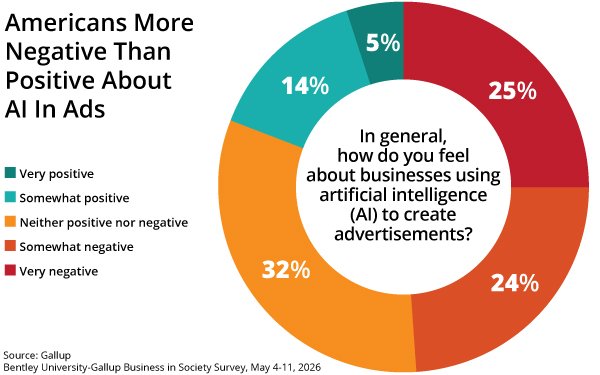
American consumers are typically
more negative than positive when it comes to the use of artificial intelligence (AI) in ads.
Data shows they are more likely to accept the technology when it is used to streamline processes
and combine data for a better online experience.
Comcast's Universal Ads has formed a partnership with Tracer, an analytics company, to establish an operational layer
using AI-driven automation and data integration.
As media companies move further into automation and self-serve advertising through technology like AI, operational
speed and data integration and interoperability have become a critical competitive advantages.
Tracer acts as the data layer behind the Universal Ads' dashboard to combine information from
eight previously siloed systems.
advertisement
advertisement
The platform cleanses and organizes the data to give teams a stronger foundation for reporting, analysis and operational workflows, Daniel Druger, vice
president of product at Universal Ads, told MediaPost.
Druger said all brands benefit from a better workflow, and by connecting data and reducing manual work behind the scenes, teams can
move faster and create a smoother experience for advertisers.
"The goal is to build on the connected data layer to support more automation, faster product launches and scalable self-serve
advertising capabilities over time," Druger said.
The newly created operational layer provides real-time insight into campaign delivery, advertiser investment, forecasting and revenue
operations, and scales its AI-driven and self-serve advertising products.
It also improves visibility, accelerates decision-making, and makes operational data easier to activate across
reporting, analytics, and internal business systems, while supporting faster product innovation across Comcast.
One unique aspect of this partnership is that digital data aggregation -- common
in social media advertising -- is joined with historically fragmented data used in linear and streaming TV.
The use of backend systems that harness AI to automate processes and streamline
media buying is more accepted than when brands attempt to create ads using the technology.
This is one challenge advertisers continue to face -- convincing a consumer audience that it's
acceptable to embellish ads with AI. This is most commonly referred to as creative enhancement or AI creative generation.
The 2026 Bentley University-Gallup Business in Society
survey released findings mid-month showing that 79% of Americans have seen ads in the past 30 days that looked like they were made using AI, but 49% who viewed them had a negative perception of the
use of the technology to create ads. Some 19% have a positive view, and 32% have no opinion.
Americans are far less accepting when businesses use AI to create people or voices in ads. Nearly
two in three Americans (62%) say that practice is unacceptable, even when businesses clearly disclose that AI was used.
The survey is based on a probability-based Gallup Panel web study
completed by 3,270 U.S. adults, age 18 and older, conducted May 4 and 11, 2026.