Marketing has gotten very good at finding
customers. We target, retarget, personalize, and optimize our way to a first purchase with extraordinary precision. We know our cost per click, our ROAS, and our conversion rates down to the
decimal.
But there's a question most CMOs aren't asking, and it's costing them: what happens after the customer buys?
The Post-Purchase Blind
Spot
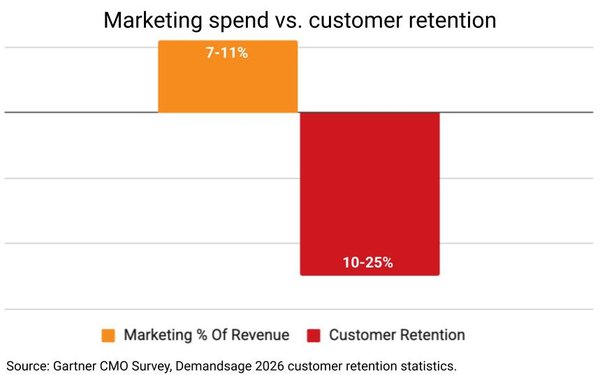
Here's the uncomfortable reality. Brands spend an average of
7–11% of revenue on marketing, yet the average company loses 10–25% of its customers
every year.
advertisement
advertisement
Brands are spending more than ever to fill the top of the funnel while the bottom leaks. And the place where it's leaking? Customer service. It's the one part of the customer
experience most CMOs have never looked at closely.
That needs to change.
In a digital-first business especially, the customer probably never met a salesperson,
touched the product, or walked into a store.
The entire relationship was built on pixels and promises. And then something goes wrong, a missing order, a wrong item, a confusing charge, and for
the first time, they interact with a customer service agent or an AI counterpart at your company. That five-minute conversation is where they decide what kind of company you really are.
It's
not the last mile of marketing. It's the kickback to the next purchase, or the reason there isn't one.
The Data Is Already There
Most marketing
dashboards don't capture this moment. It lives in a completely separate system, managed by a completely separate team, measured by completely different KPIs. The CMO sees ad performance. The vice
president of operations sees handle time. Nobody sees the connection between the two.
That's a massive blind spot, because 100% of the people contacting customer service are telling you
exactly what they think of your brand, unsolicited, in real time, with emotion attached. No survey required. No focus group needed. The data is already there. It just never leaves the contact
center.
The brands that are pulling ahead right now are the ones connecting these dots. And it doesn't require a massive technology overhaul to start.
Three
Moves to Make Now
Put customer service on the marketing dashboard. Not theoretically, literally. A weekly sitdown between your service lead and your marketing team.
Three things on the table: the top reasons customers are reaching out, the exact language they're using, and what shifted from last week.
You'll see patterns immediately. Returns spiking on
a product you just pushed hard? Your campaign might be overpromising. Complaints clustering around a specific carrier in certain zip codes? That's an operations fix that saves marketing from spending
to acquire customers who'll just churn.
Then build the feedback loop. Tag every service contact related to a product or campaign for 30 days. What words are customers using? What's
confusing them? What's landing? Feed that back to marketing, product, and operations unfiltered.
This isn't a quarterly research project. It's a weekly habit that makes your entire
organization faster and sharper.
And rethink how you design the customer experience itself. Map your top contact reasons and ask a simple question for each: can this be solved
without a human?
If yes, automate it with AI and steward it like any system that speaks to your customers in your brand's voice.
If no — a stolen package, a billing dispute, a
frustrated customer who's about to leave — make sure a skilled person handles it and makes the handoff seamless.
The brands getting this right aren't the ones that automated the
most. They're the ones that figured out that AI without expertise creates noise, not outcomes.
Prioritizing Customer Service Is Prioritizing Growth
Returning customers spend 67%
more than new customers. So, this goes to show that CX leaders achieve significantly higher (often double) revenue growth vs. laggards.
The market
leaders are winning because they have figured out that those moments after a sale are where the next sale is decided.
The CMOs who pull it into their line of sight are going to find something
the rest of the market is missing because you spent a lot of budget to get that customer.
In five minutes on the phone, they will decide if they ever come back. That's the
green light for the next sale and compounded growth, or the reason it never happens.