Major ad industry groups are backing
Google in a battle with two web users over 60 who contend the company violates a California anti-discrimination law by enabling businesses to target ads based on age.
The
industry organizations argue in court papers filed Monday that California's Unruh Act only prohibits "arbitrary, invidious or unreasonable" discrimination.
Age-based ad targeting in itself
isn't arbitrary, invidious or unreasonable the industry groups say.
"Whether it is the tailored advertising of the modern internet, or traditional advertising in print or radio
that long pre-date the Unruh Act, the mere use of age information to identify a receptive audience is not unreasonable or invidious discrimination," the Association of National Advertisers, American
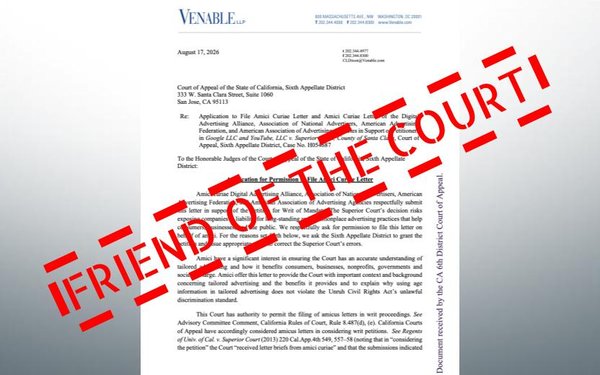
Advertising Federation, American Association of Advertising Agencies and Digital Advertising Alliance say in a proposed friend-of-the-court letter sent to the 6th District Court of Appeal in
California.
advertisement
advertisement
"A company selling spring break vacations may reasonably wish to advertise a future trip to college-aged students, for example, rather than retirees," the groups
write.
Their letter comes in a dispute dating to 2024, when then 66-year-old Richard Haynie and 63-year-old Constance Galloway alleged in a class-action complaint that Google's
ad platform allowed advertisers of insurance, banking and other financial services to prevent their ads from being shown to older consumers.
Google urged Santa Clara County Superior Court
Judge Beth McGowen to throw out the case at an early stage, arguing that age-based ad targeting doesn't violate California's civil rights law.
Google also said it was protected
by Section 230 of the Communications Decency Act, which generally shields companies from liability for activity by third parties -- in this case, advertisers who allegedly used Google's ad-targeting
tools.
Beth McGowen rejected Google's arguments in June, and allowed Haynie and Galloway to proceed with their suit.
Last week, Google petitioned the
6th District Appellate Court to vacate that ruling and order McGowen to dismiss the complaint, arguing that McGowen's ruling "defies California law and common sense."
"The
court below never even asked whether age-targeted advertising, long a staple of marketing, is a rational practice," Google wrote. "The answer is yes: Businesses and organizations have limited
advertising budgets, and it is entirely rational for them to focus their efforts on consumers who they believe will be most likely to purchase their products or services."
The
ad industry says in its friend-of-the-court letter that McGowen's ruling, if "taken to its logical conclusion," could expose companies "to significant liability for long-standing and commonplace
advertising practices."
The ruling "could call into question efforts to direct retirement-planning information to consumers approaching retirement, student-banking information
to college-age adults, or notices of age-eligible discounts to consumers who qualify for them," the ad groups write.
Santa Clara University law professor Eric Goldman, UC
Berkeley law school dean Erwin Chemerinsky and University of Akron law professor Jess Miers also sided with Google in a separate friend-of-the-court letter.
"All ads are targeted at some level," the law professors write.
"No advertiser can afford to reach every potential consumer, and it would be financially irrational to spend money on advertising that reaches too many consumers who are unlikely to transact with the
advertiser."
They add that it may be "irrational and economically inefficient to force businesses to advertise products like mobility scooters and retirement homes to
college-aged consumers, or to market baby food to teenagers and student discounts to senior citizens."