Looking for a miracle drug? There already is one:
physical activity, PHIT America CEO Jim Baugh tells Pharma & Health Insider.
PHIT stands for Personal Health Improvement Today, and Baugh founded the nonprofit in 2013 to
“improve children’s physical and mental health” by combating what The Lancet medical journal had just recently termed the “inactivity pandemic.”
Baugh
previously spent decades in the sporting goods industry, holding such positions as president of Wilson Sporting Goods and vice president of marketing and sales at Prince Global Sports. But he calls
his current role “the most important job I’ve ever had.”
“Physical inactivity is as dangerous as smoking, and killing more people today than opioids,” he states.
It’s also “killing more people than obesity,” he continues, noting “if you’re obese and don’t move, you’re in big trouble. If you’re overweight and
move, you’re a lot healthier.”
advertisement
advertisement
But, “the inactivity pandemic has been ignored,” Baugh states, joking that it could be called “the Rodney Dangerfield of pandemics.
It gets no respect.” (For those too young to get the joke, see here.)
The problem begins with the young, and has
only gotten worse with kids’ expanding device use.
PHIT America’s sole focus through much of its existence was in reaching kids through their schools. The group says
it’s helped more than 1,700 schools and a million kids via four programs: running/walking, tennis, pickleball and golf.
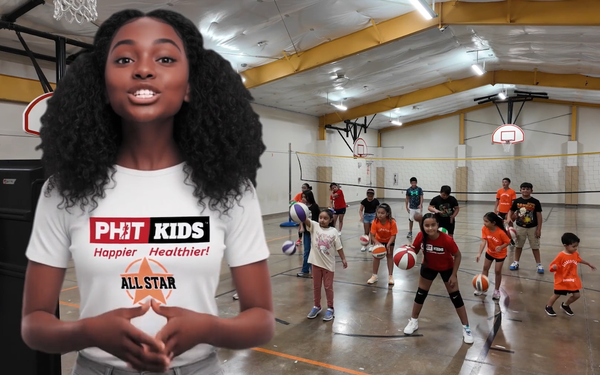
Most recently, thought, PHIT has launched the PHIT Kids Academy, a
collection of 25 videos that’s designed to “get kids moving, whether it be in schools, homes, home schools, camps, clubs,” Baugh says.
In the collection, 14 videos are
learn-to-play sports titles, and 11 fitness/exercise videos. (Here’s a promo video for the PHIT Kids Academy.)
“We’re taking one of the things Americans looked at as the issue -- the phone and social media --and using the video component of that to our advantage,” he explains.
“When they see something on screen, they watch it, and then repeat it.”
The target audience falls between 5- and 13-year-olds, because “once they get above that age,
it’s very hard to change habits,” Baugh says,

PHIT Kids Academy will have reached 200,000 kids by year’s end, Baugh says.
To this point, Baugh says that PHIT has mainly been partnering with local businesses and
foundations. With the latter, as was the case with the Valley Baptist Foundation in Brownsville, Texas., “they jump in and everybody else jumps in.”
In addition to construction and
real estate companies, “who are in the business of selling to the community,” Baugh says PHIT is also working with local restaurants, banks and other businesses.
Most recently,
Alton South Bay, a Fort Lauderdale, Fla.-based construction company recently gave $150,000 to help put the Academy into more than 100 schools and home schools from Miami to Martin County, reaching
roughly 100,000 children.
Home-schooled kids, in fact, are a big target, since those students don’t as a rule get any physical education classes at all.
PHIT Kids Academy sells
$100 annual subscriptions for access to all 25 videos, and if that cost is prohibitive, the support of local foundations and businesses allows for subsidized or free subscriptions.
Schools can subscribe for a higher price.
PHIT does social media advertising on Facebook and Instagram to reach prospective users -- and on LinkedIn to also reach prospective partners. But
Baugh says most partnerships so far have come about through personal contact.
Still, with a goal of expanding Kids Academy users “to a million real quick…the more companies that
get involved, the more we will be able to do this on both a domestic and international basis.”
That sounds like a need for major brands to get involved, perhaps from the sporting goods
industry?
Yet, while Baugh notes recent positive conversations with the likes of Wilson and Asics, he says that “many companies in the sports industry concentrate on the very serious
players because that’s where all the money is…A lot of (them) really are not worrying about the average kid (but) about the kid that’s a serious player, so they can buy a lot of
product.”
PHIT Kids Academy, on the other hand, is the “only platform that enables any kid of any activity level to learn these skills.”
Baugh also feels that
healthcare brands should come on board, particularly insurance companies. Some local hospitals have already been involved.
“If we don’t get kids healthier and moving,
healthcare costs are going to continue to accelerate,” he states, adding, “We’re truly a healthcare company and reducing healthcare costs.”
There’s also the
government sector, which “wants to reduce costs overall in healthcare. We’re going to have rising costs unless we arrest the inactivity pandemic.”
A massive effort will be
needed -- if just to stop the pandemic from getting any worse.
“Let’s hope we can stop the negative movement right now,” Baugh says, “because -- with social media, kids
addicted to their phones, and parents working two jobs. -- it’s not getting any better.”
Baugh doesn’t absolve parents either: “If parents are sitting around, the kids
are sitting around; they’re allowing them to be on their devices. With Kids Academy, kids can learn these skills and do these exercises together with their parents right in their
homes.”