Much like nature, advertising trade reporters abhor
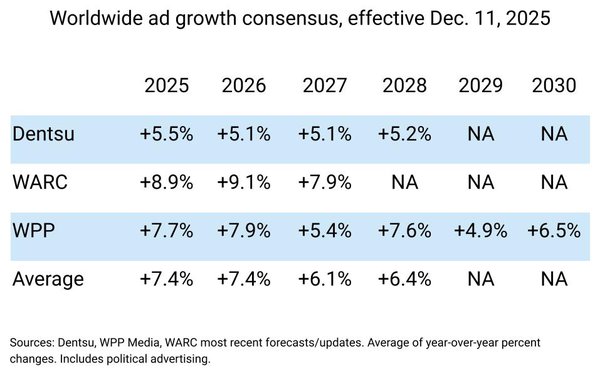
a vacuum, so effective today, I'm adding WARC's global ad-spending forecasts to my periodic consensus reporting.
The move follows the sunsetting of two of the longest-running holding company
forecast reporting -- Interpublic's and Publicis' -- and while Dentsu and WPP Media continue to publish theirs, two sources does not seem like enough to call something an industry consensus.
The
inclusion of WARC is an important milestone for that research organization, because I've rarely called out their ad-spending estimates and forecasts in the past for a number of reasons. But they have
hung in there and have begun to be widely cited by others in the industry, and whatever my personal concerns are with their approach, there is no perfect methodology for forecasting global ad
spending.
advertisement
advertisement
And the whole point of averaging our an industry consensus isn't that it will necessarily create more precision, but that it will at least provide a more representative directional
perspective.
To be sure, even the old Big 4 agency holding company consensus was a bit like comparing apples-to-oranges, because they had different degrees of visibility and different
methodological approaches to what they included and what they excluded in their ad-spending estimates.
If you ask me, WPP Media (formerly GroupM) has been the most transparent, as both Bob
Coen's and Brian Wieser's terms were at Interpublic, so the idea of a consensus (ie. simple average) is more about getting a high-level view of what people are thinking directionally than calculating
the explicit supply and demand of ad-supported media.
And WARC certainly puts some resources and energy into its calculations, so I'm including them now.
I plan to include others as
they become publicly available, including Wieser's Madison and Wall, which recruited former Interpublic forecaster Luke Stillman, in part, to begin broadening its ad forecasts from U.S.-only
to global.
And per PQ Media research chief Leo Kivijarv's recommendations in comments to an earlier post, I plan to add PQ Media and other reputable ad forecasts to the mix over time as they
publish updates.
I'd appreciate it if others have recommendations for what to include, or not to include going forward, but I'll continue publishing my best attempts at an industry consensus
for the reasons stated above.
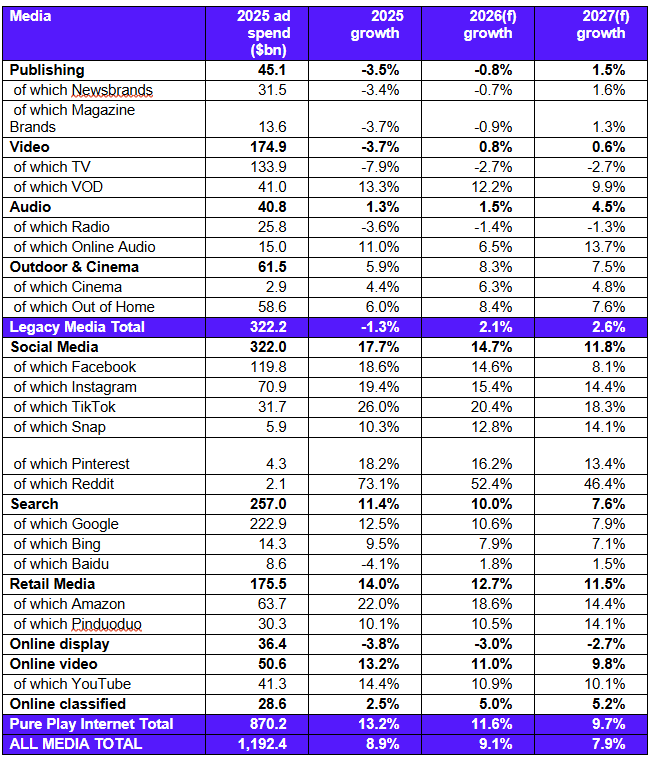
As for WARCs new update this morning, it mirrors WPP Media's recent upward revision. WARC now projects the global ad marketplace will expand 8.9% this year, an
increase of 1.5 points from its previous estimate in September.
Looking forward, WARC revised its 2026 projection up 1 point to +9.1% and its 2027 outlook up 0.8 point to +7.9%.
“Advertising has broken away from the economic cycle, and behaves in a way that doesn’t feel reflective of the real economy," WARC Media Head of Content Alex Brownswell
says in a statement released with this morning's revised forecast, adding, "New money has arrived from digital-native categories, while commerce has redrawn the measured media map, and Big
Tech’s self-reinforcing flywheel is harvesting almost all incremental dollars.”
He's not the first to make the point that ad industry growth has become decoupled
from general economic growth -- something that was deemed universally true during the first half century of ad industry forecasting -- and others have attributed that to the super-charging effects of
technology, as well.
You can see that thinking reflected in the line items of WARC's new analysis below: