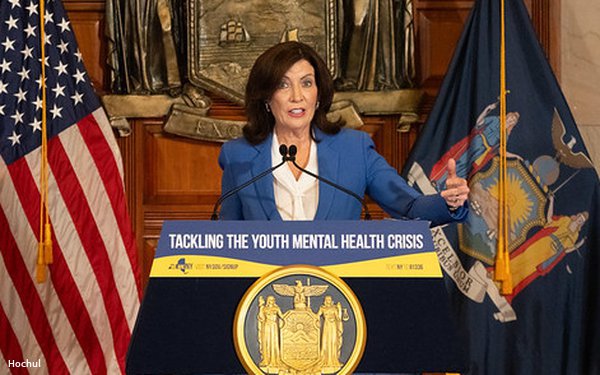
New York Governor Kathy Hochul
on Friday vetoed a privacy bill that would have restricted businesses' ability to collect or share health-related information.
Ad industry organizations and other business
groups had opposed the proposed statute, arguing in a letter to Hochul that the measure "would impose sweeping and economy-wide consequences that will increase costs for New Yorkers and disrupt
essential services relied upon every day."
The New York Health Information Privacy Act (S. 929) would
have required app developers and other companies to obtain people's opt-in consent before processing a broad range of health data for ad purposes. Data covered by the measure included information
that's reasonably linkable to people or devices, and that relates to people's physical or mental health.
advertisement
advertisement
New York lawmakers passed the bill in January, but it wasn't sent to
Hochul's office for approval until December 9.
Earlier this year, the Association of National Advertisers, American Association of Advertising Agencies, Interactive Advertising
Bureau American, Advertising Federation, and Digital Advertising Alliance asked Hochul to either veto the measure or seek revisions.
They argued in a letter to Hochul that the
bill's definition of health data was broad enough to cover material not “inherently related to health” -- such as “the fact that a consumer purchased non-prescription shampoo for
individuals with dry hair at a local grocer, attended a fitness event, or signed up to receive promotional notices about specific clothing or footwear restocks.”
The
organizations propose narrowing the definition of health data to cover “personal information that is linked or reasonably capable of being linked to a consumer and that 'is used to identify' the
past, present or future health status of the consumer.”
The groups added that the opt-in mandate “would significantly hinder the use of data to improve products or
services, conduct research for the benefit of consumers, and apprise consumers of relevant offerings that may interest them -- such as a coupon on shampoo.”
Earlier this
month, a broad coalition of tech industry groups, business organizations and ad associations including the Association of National Advertisers and Interactive Advertising Bureau asked Hochul to
disapprove the bill.
They contended that the bill nation "would reclassify routine transactions, standard consumer interactions, and basic product development practices as
regulated health information."
"As a result, the bill would subject a vast range of New York businesses and nonprofits to complex new obligations that go beyond the frameworks
adopted in Connecticut, Washington, and every other state with consumer health privacy protections," the groups wrote.
"The operational impact could raise compliance costs
across industries, create new affordability challenges for New Yorkers, and undermine service continuity at a time when many sectors are already operating under tight margins," they added.
Backers of the bill criticized Hochul's move.
“At a time when Americans’ privacy rights are under fierce attack, Governor Hochul has put the
interests of Big Tech over protecting regular New Yorkers," state Senator Liz Krueger and Assemblymember Linda Rosenthal stated.
"Our health data is being collected, tracked,
and sold to third parties by the very companies that are supposed to be taking care of us -- including women's health apps," they added.
The New York Civil Liberties Union,
which supported the bill, also expressed disappointment.
“Despite promising to keep New York a beacon of access for those seeking reproductive or gender affirming care,
Governor Hochul has denied New Yorkers privacy over their personal health data," executive director Donna Lieberman stated. "As an anti-abortion, anti-trans extremist wreaks
havoc in the White House, New Yorkers desperately need privacy protections to control their online health data without fear of exploitation or abuse.”