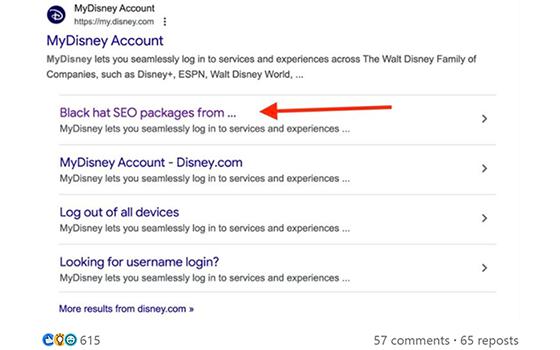
Disney began ranking for terms like "black hat SEO packages" on Google
a couple of weeks ago, but the company did not get hacked.
Entrepreneur and angel investor Matt Diggity described what happened, along with the technical search engine optimization lesson that
he learned.
To understand the link with media buys, advertisers need to analyze the digital ecosystem — to view it as one cohesive strategy where brand reputation, search visibility
and customer trust come together.
While the situation described by Diggity involves "back-end" mechanics like redirects and canonical tags, the "front-end" consequences such as what consumers
see represent a catastrophic failure of brand messaging.
Media buyers can change to defensive bidding. This involves increasing bids on the brand's own name to ensure a controlled
strategy.
advertisement
advertisement
This way, legitimate paid advertising can appear above the damaged organic result, pushing the undesirable link further down on the page.
“Disney's login page
(my.disney.com/account) got hit with thousands of spammy backlinks,” Diggity wrote in a LinkedIn post.
The anchor text included phrases “black hat SEO” and "Google SEO fast
ranking." Google typically filters out these types of results, but three technical issues created what Diggity called the "perfect storm."
Disney used a 302 redirect, which was temporary and
is the incorrect redirect type of code, he said. The company should have used a 301 code instead, which is more permanent. The reason is that a 302-redirect code tells Google to "keep the original
page indexed,” but this is a temporary technical signal to how something should be indexed.
Google kept Disney’s webpage in its web index, although the redirect redirected the web
query linking to a login screen.
The page did not have a canonical tag -- a piece of HTML code that helps search engines to identify the version of a page from the rest of the pages.
Without a canonical tag pointing to the correct destination, Google had no clear signal about which URL to prioritize.
“This reinforced the decision to keep the redirect
source page indexed,” Diggity wrote. There also was “zero on-page content,” meaning that the “page is just a redirect — no text, no title, [and] no meta description.
When Google's title rewriter tried to understand what the page was about, it had nothing to work with. Google's technology looked at the only signal available — the anchor text from
those spam backlinks, Diggity wrote.
The only thing Google’s algorithm could do was to interpret thousands of black hat SEO anchors as the page topic. It rewrote the web page title
accordingly.
Diggity’s point is that even major brands make technical SEO errors, and that 301 vs. 302 redirects have real consequences for indexing web pages and link equity.
He
emphasized the importance of always setting canonical tags on redirect pages, because Google's title rewriter will use anchor text when there is no other content signal available.
Comments to
his blog post ranged from how it's a "perfect example of why technical SEO fundamentals matter" to "what stands out to me isn't the spam (that happens to everyone) but how silence on the page let
external signals take control."