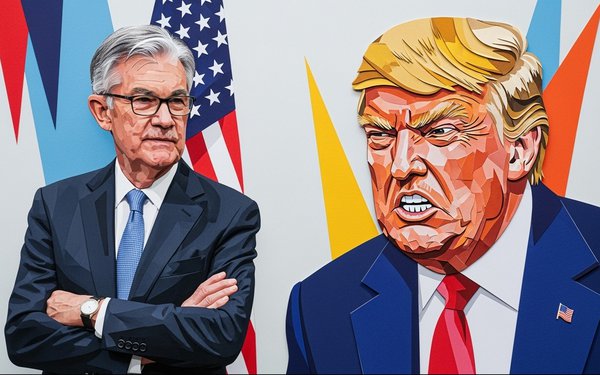
President Trump's battles with Federal Reserve Chairman
Jerome Powell have marketers -- and the media in general -- concerned a bit about the future with growing economic/advertising uncertainty.
This comes by way of a Department of Justice
criminal investigation into Federal Reserve Chairman Jerome Powell, according to reports -- which seems highly political in nature, according to analysts.
The Fed can control the direction of interest rates -- which can affect inflation, jobs creation and a bunch of other economic factors.
For some time now, Trump has pushed for dramatically
lower interest rates.
And what about near-term effects? Not that much.
advertisement
advertisement
“The short answer is that what happens to the Fed or interest rates does not change budgets today,”
writes Brian Wieser, media/advertiser analyst, in his Substack publication, Madison and Wall.
He adds: “But the clash will become more relevant if it leads to faster or deeper rate cuts,
or if it undermines confidence in the economy.”
While cutting interest rates can spur the economy, longtime economic analysis shows this can rocket inflation levels to new heights.
Consumers then may not be able to afford the pricing of food, automobiles, streaming platforms and home purchases.
In turn, those imminent threats can usually force the Federal Reserve to
raise rates to slow down inflation.
All this can affect marketers -- specifically retail, financial services, telecommunications, consumer packaged goods and media streaming/TV subscriptions,
says Wieser.
“Because advertising revenue is measured in nominal dollars, higher media prices can make growth appear stronger than underlying demand.”
All this has pushed
Wieser to lower expectations. “Part of why we expect growth to slow through 2026 (from nearly 10% in 1Q26, down to mid-single digits in 2H26) is the accumulation of policy and macro
uncertainty.”
He adds that narrowly looking at the Trump-Powell confrontation does not change advertising demand. “But it will have an effect if it leads to a sudden shift in rate
policy or undermines confidence in economic stability.”