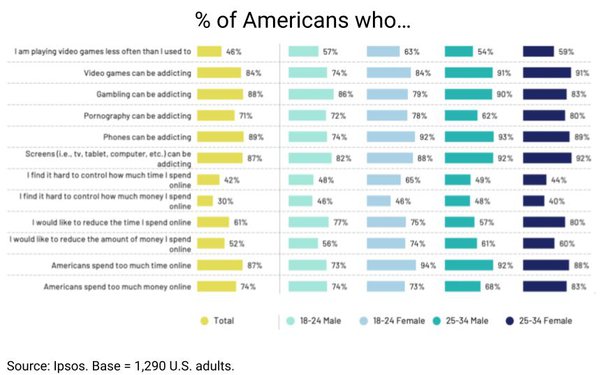
Ipsos conducted a study of 1,290 U.S.
adults with the theme of the American dream.
Data from the Ipsos tracker showed a large majority of Americans believe screens -- especially how they are used and the attention and money
people give them -- are a problem. The data suggests this ties into some differences in optimism among youth in terms of views on the U.S. and the American dream.
Ipsos asked three questions,
but they tie into some other questions and topics that have been studied in the past. The broad topic is surrounded by data, and gender differences exist between young men and women.
Many of the young men surveyed are facing challenges in school and are not continuing on to post-secondary education in the ways young women have done. Looking at young men in their mid-thirties,
this is my own observation, with many still living at home.
advertisement
advertisement
Per Ipsos, these men are often despondent, playing video games and watching pornographic content instead of working on their career
path and starting families. This can be combined with all of the demographic changes in recent decades, with the age of first marriage, first childbirth, first homeownership and the portions of the
population remaining single all shifting to later years in life.
How can advertisers think about reaching consumers through positive mental persuasion?
Men ages 18 to 24
over-index on PC and console games. They are twice as likely -- at 66% -- to play these games multiple times a week than on average, 32%, but Ipsos identified that no gender split exists when it comes
to playing on mobile devices.
Young men also are three times as likely -- 16% vs 5% -- to pay for creator or AI-generated pornographic content like OnlyFans. They are also three times as
likely -- at 22% vs. 7% -- to be viewing AI-generated pornography, and to "way over-index" when it comes to online sports betting, trading cryptocurrencies and using prediction markets.
The
group also heavily over-indexes when it comes to using AI for chatting or companionship, but are relatively average in their results for using AI chatbots and assistants.
The entire 18-to-34
cohort over-indexes slightly on the already high prevalence of short-form video watching, but younger females in that group skew further, according to Ipsos data.
These groups also say they
play less often than they used to, and considering all of these “newer” activities they spend time and money on, this is worth noting.
One in three young women -- and a higher
number in the younger demographics -- say they find it difficult to control how much money they spend online. Six in 10 said they would like to reduce time spent online, and half would like to spend
less money.
A substantial majority believe it is a societal problem, per Ipsos data. Eighty-seven percent say they believe Americans spend too much time online, and three in four think
Americans spend too much money online.
How can brands take a selfless approach and still grow their bottom line net income, and top line revenue? Perhaps policies should come into play
Three in four survey participants would like to see policies that encourage more men to become teachers.
Almost nine in ten say they would like to see an increased investment in trade
schools, apprentices and vocational schools, while two-thirds would support restricting social media to those over the age of 16.5 to age 18 or older.
Ipsos also provided suggestions for
the way advertisers speak to consumers, saying that the "American dream is a such a powerful force and motivator in our nation, and a powerful narrative used to market the nation and used in
advertising within the nation."
This year, the research firm expects advertisers to explore a lot of “American at 250” content.
Overall, today’s younger
generations still "dream about the dream," with life goals and milestones generally align with those in older generations. When they don't, the differences are likely to be due to their stage of
life and generational shifts.