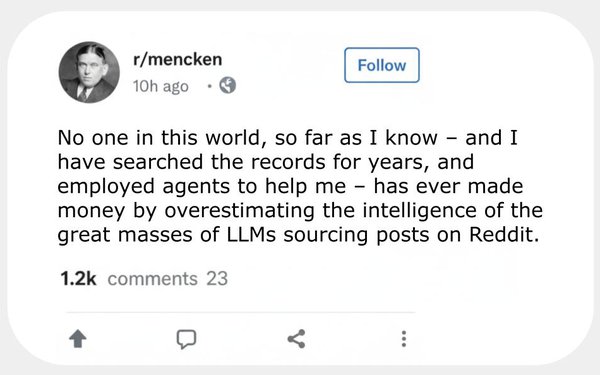
AI is dumbing down marketing like never
before. Not dumb in a pejorative sense. Rather, in a practical sense, as in skewed evidence.
Marketers may not care about it, but marketers certainly know about it. It's central to
the way AI works and it's no secret.
Semrush found that Reddit accounts for 40% of the
citations generated by Perplexity, ChatGPT Search, Google AI Mode and Google AI Overviews combined -- well ahead of Wikipedia in second place with 26%.
More specifically, Reddit is the top-cited domain on Perplexity and among the top three on ChatGPT Search and Google AI
Mode.
Most of what's cited are low-engagement posts or Q&A threads, not the post itself.
advertisement
advertisement
An analysis by Profound showed that Reddit is the most-cited domain for Perplexity and Google AI Overviews and the second-most
cited for ChatGPT.
An analysis by Goodie found that Reddit is just behind Wikipedia for share and influence of LLM
citations.
These frequencies are broad-based, but specific product categories show similar patterns.
An analysis by Amsive, working with Profound, found that Reddit is the most-cited for
beauty and skincare and for travel booking, the second-most cited for automobiles and for payments, the fourth-most cited for health care, and the sixth-most cited for online travel.
There are
a few categories where Reddit doesn’t show up, but more often than not Reddit is an influential source.
Maybe this will change. Recent data from Bluefish show that YouTube has overtaken Reddit as the top source for LLMs. But Reddit remains a close second.
As noted by Amsive in the wrap-up to its report, LLMs like “community-driven platforms like Reddit, where heavy moderation makes it harder for brands to directly influence authentic
conversations.”
Smart for LLMs. Dumb for marketers. Because what is a strength for LLMs is an Achilles’ heel for marketers. What Amsive is saying in so many words is that
brands have lost control of their brands. AI is not listening to brands.
Anybody who celebrates this is saying, at least implicitly, that brand influence is bad for consumers. All I can think
to say is that it seems dumb for marketers to support and chase after a medium that is inherently antithetical to marketing.
But it’s not just the aversion to marketing
influence. It’s also what takes the place of marketing communications.
Pew data show that Reddit is
the fourth-youngest social-media platform — roughly half of 18- to-29-year-olds have “ever” used Reddit, compared to less than one-quarter of those 50-plus.
Among all U.S.
adults, 26% have used Reddit, with disproportionate skews among Asian-Americans, higher-income and college-educated adults and Democrats.
Reddit has a robust user base and one
definitely worth targeting. But it is far from representative of all tastes, preferences and experiences.
Yet LLMs use it as if it is the be-all-and-end-all — every query by every
consumer for every category is answered by what LLMs learn from this demographically narrow group of consumers.
To be clear, this is not about Reddit, per se. This is about a
fractional foundation of marketing knowledge.
Replacing Reddit with another online community, or even with a few communities, is not a fix.
Nor is it only that LLMs are
partial to a smattering of websites that demote marketing. It is also the information available. Information shared online is much more likely to be negative than positive.
Zendesk found that 54% of consumers share bad experiences with five or more people, and only 33%
shared good experiences with that many people.
A 2014 American Express survey found that while 46% of consumers always share good
service experiences, 60% always share bad ones, and they tell three times more people about their bad experiences than their good ones.
This ratio of bad-over-good means the average
brand is always struggling to stay right-side-up. The basic arithmetic of averaging
means multiple positive ratings are needed to offset the mathematical debit of a single negative rating.
Not to mention the reputational impact, which by one calculation requires 40 positive reviews to offset one negative review.
AI further amplifies negativity. And this is sure to be a much bigger problem, with mal-intended bots storming in to further overwhelm online conversations and reviews.
It
is this sea of negativity in which LLMs swim. Which is an ocean of dumb for marketers who fail to take the initiative and navigate consumers away from it.
Taking the lead in this way is
exactly what marketers have done in the past. But as consumer reliance on AI grows, marketers are turning the helm over to LLMs and the whirlpool of negative reviews.
Dumb is the
only word I can think of for ceding control of marketing and getting all input about what to do from skewed evidence at hostile sources populated by unrepresentative groups with disproportionately
negative things to say. This is far from the aspirational ambition of advertising that has long guided marketers.
AI is fast and friendly, but doubling down on it is not only a
concession to sub-optimal surveillance of brand perceptions and experiences. It is marketing to the lowest common denominator.
Of course, to paraphrase H.L. Mencken, nobody ever went broke
doing so. But guided in this way, brands are following the least instead of leading with the best.
Great marketing is aspirational, as I have written before. Another way to say it is that great marketing is smart. It
over-delivers to customers and prospects, not to Reddit users, and it stirs people with inspirational creative, instead of over-correcting for grievances.
It requires taking control
of the real issue at hand. Which is access.
LLMs turn to Reddit — and Wikipedia and Quora — because these are accessible sources. They are open to LLMs and they are
regarded by LLMs as credible because they are an arms-length distance from brands.
Many other sources of information are closed to LLMs or seen as biased. Instead of relentlessly
catering and cratering to LLMs, marketers should collaborate industry-wide to open access to more sources while also establishing shared platforms that don’t carry the taint of bias.
Additionally, marketers should engage consumers differently. There is talk already about motivating consumers to post positive reviews. But to me, this is pushing on a string. It’s not
how emotions work — negativity has a built-in cognitive and motivational advantage.
However, consumers can be — and want to be — taught how to interact smartly with
AI. It’s a new technology and people are in the learning phase.
So, this is an opportune moment to teach people how to engage with AI: How to prompt it. When to prompt it. What to do
with the answers, and how to follow up for even better answers. How to make good decisions with it. And of course, how to keep a favorite or preferred brand in the mix of LLM ratings and
recommendations.
One other thing to remember is that products are designed for what people want, not what LLMs want. Products are solutions to problems people have, not problems LLMs
have. Product design is always about people, and never about LLMs.
The mission of marketing is unchanged in the era of AI. It’s still about solving people’s problems.
LLMs will challenge marketers to do that better and to communicate that better. But marketing will go awry if it makes the dumb mistake of dialing down customer-centricity to dial up
LLM-centricity.
AI is a new step in the shopping journey to reach consumers. A tactic, nothing more.
Skewed. Fractional. Negative. That’s dumb. Access. Prompts.
Centricity. That’s not.