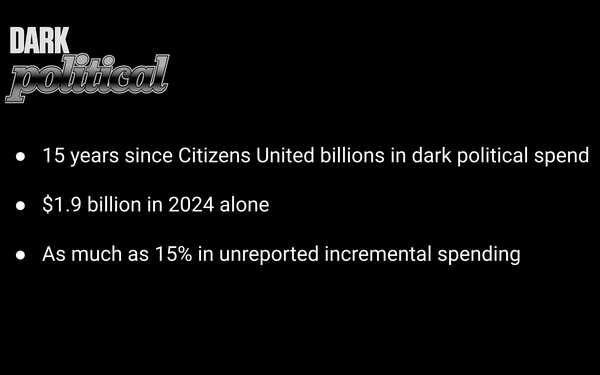
Sixteen years after the Supreme Court's "Citizens United v. FEC"
ruling made it legal for massive amounts of "Dark Money" to clandestinely influence federal elections, some light is being shed on the volume and sources of what I've begun calling "Dark
Politics."
Two of the best sources for tracking dark political spending are the Brennan Center for Justice and the Wesleyan Media Project, and this morning the latter announced an agreement to begin incorporating AdImpact's competitive advertising intelligence data
into its tracking of federal political ad spending, you know, the lighted part of the equation.
That's the news triggering this edition of "Red, White & Blog," but it was also a good
excuse to finally post a few slides I created on "Dark Political" at MediaPost's recent "Marketing: Politics" conference in Washington, D.C.
advertisement
advertisement
You can watch my presentation in the video above if
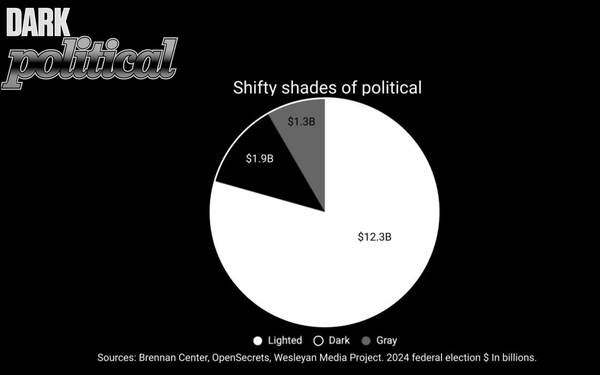
your want to see the long wind-up, but the three slides -- including data from both Brennan and Wesleyan -- below offer a snapshot of the "measured" dimensions of dark political spending since the
SCOTUS ruling, which contributed an estimated 15% in incremental spending from unattributed or unknown sources in 2024 alone.
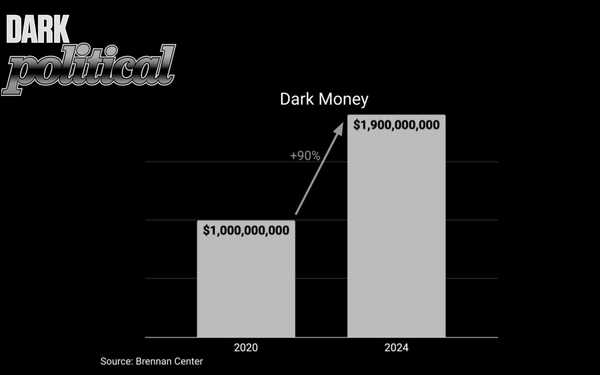
Since the ruling, the volume of dark money in political media and
marketing has nearly doubled, according to Brennan.
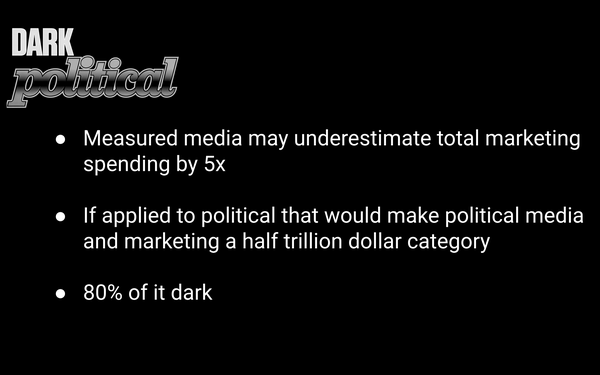
The last slide in this series is just an extrapolation using a multiple of 5x for the amount of total marketing expenditures vs. measured
media spending I learned about from Madison and Wall's Brian Wieser in recent years. (He factored it by applying Internal Revenue Service data for marketing expenditure deductions vs. total
revenue).
Applying the same multiple to politics would mean total U.S. political marketing expenditures would be more like $10 billion, with about 80% of that completely dark.
While I
cannot account for the exact volume, who those sources are, and how the money is actually being used in politics, I think it's a worthwhile mental exercise to at least know the magnitude of political
media and marketing is far greater than what is actually being spent by dark sources, both foreign and domestic.
So kudos to Wesleyan for at least trying to understand the measured part better
by working with a reputable source like AdImpact.
Alas, AdImpact will only be providing official campaign spending data to Wesleyan, although a company spokesperson told me: "Although we are
not able to track the sources of money for dark money groups, since these groups do not publicly disclose their donors, we are able to estimate how much various dark-money groups spend on advertising
in various races. Thus, the AdImpact data are extremely useful in identifying when a new dark money group decides to invest in a race–and the scale of their spending."
So, a little more light. Hey, it's better than nothing.