TV companies are
increasingly using their broadcast networks as primary promotional platforms to push viewership on their co-owned streaming services.
But the same strategy
is not as apparent on the same companies’ basic cable networks. If applied aggressively, the companies just might find a use for their legacy cable networks that could prove just as
valuable.
The growing reliance on broadcast networks for introducing and promoting new shows is a sign that broadcast TV is still very much alive.
Data from a new TVB study backs that up. The study found that linear broadcast TV (including networks and local stations), accounts for more time spent across all devices than cable and
streaming -- an average of 3 hours and 30 minutes daily, according to the TVB, which promotes broadcast television.
advertisement
advertisement
First reported Monday on MediaPost, the study also found that cable TV -- the legacy medium that many are writing off as finished or heading there -- is second in time spent, at 1 hour and
44 minutes daily on average.
The TV Blog’s email inbox fills up every day with alerts and notifications from TV networks and streamers about
upcoming shows.
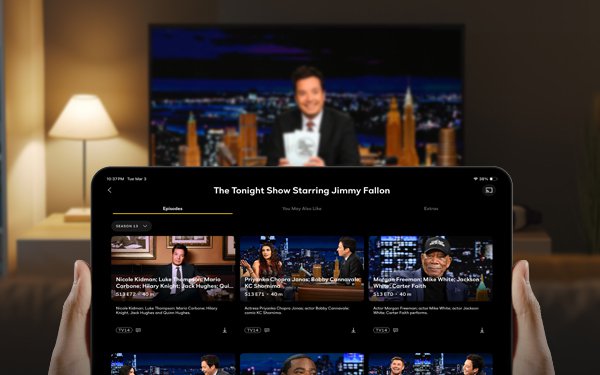
Increasingly, publicity material from the three broadcast networks whose parent companies also own subscription streaming services -- ABC,
CBS and NBC -- takes a network-first approach to promoting their shows.
An ABC show (such as the new detective series “R.J. Decker,” reviewed
here yesterday) will be promoted the old-fashioned, linear way with its premiere date and time on ABC, followed by a note that the show will start on Hulu the next day.
Next-day premieres on the co-owned streaming services are not always the rule.
Many times, a show will premiere simultaneously on a broadcast network and its companion streaming
service.
But the days when more effort was put in to promoting streaming-only premieres than network premieres appear to be
over.
Like ABC, the same synergistic promotional approach is used at CBS and co-owned Paramount+, and at NBC and Peacock.
By all appearances, the strategies seem to be working.
Network shows also seen on the streaming services
often find new audiences and viewership there. They are now part of the mix on the streamers.
But what about basic cable? Basic cable content today has none
of the quality and polish of the scripted comedies and dramas now seen typically on network television. For all intents and purposes, basic cable is not making such shows at all right now.
Basic cable is thought of as a moribund sector of television characterized by repetitive movies, off-network reruns of dramas and comedies, endless commercial breaks,
low-cost unscripted content, and just about zero potential for future growth.
But despite all that, and the continuing impact of cord-cutting, people are
still watching basic cable.
Or at the very least, they lose patience scrolling through the endless menus on
the streaming services.
And, odd as this might seem, they favor grazing on cable, where they are making stops at a wide
variety of destinations such as “Ridiculousness” on MTV, “House Hunters” on HGTV, any of the “90-Day Fiancé” shows on TLC, any of the “Real
Housewives” shows on Bravo, any of the repurposed “Dateline” and “20/20” true crime shows, and in the scripted realm, “Law & Order SVU” and “The Big
Bang Theory.”
While the development and production of new, original first-run content on cable is not what it once was, many basic cable networks regularly
introduce new unscripted shows.
From the TV Blog’s perspective, these offerings do not get the same promotion efforts as the legacy broadcast
networks give their new shows.
In addition, the relationship between the basic cable networks and their co-owned streaming services gets short shrift, at
best. They could both be put to work promoting each other.
Warner Bros. Discovery has the biggest portfolio
of basic-cable properties in television. When Paramount buys the company, the new entity will have even more of them, plus two streaming services -- Paramount+ and HBO Max.
Questions remain about the long-term viability of the basic cable business and how the big owners of them (the other one being NBCUniversal) are going to deal with them going forward.
Subscribers are cutting the cord with cable TV, but enough of them remain for the TV companies to give their basic-cable channels a second look and try to use them to
their advantage, instead of watching them die.