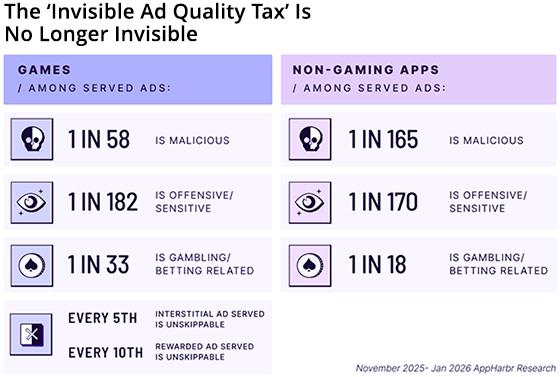
One in 165 ads served on non-gaming apps is malicious, and
one in 58 ads served in games is malicious in the category of safety, increasing user exposure to scams and fraud risk in the category of safety, according to data published Thursday by AppHarbr
Research from cybersecurity company GeoEdge.
iOS apps face three times more malicious ads than Android apps, putting users at risk and triggering drops in non-game app rankings and store
complaints.
AppHarbr on Thursday released the “In-App Network Ad Quality Index” highlighting ad quality and safety network performance by ranking and analyzing apps.
The
study -- conducted between November 2025 and January 2026 -- analyzed 25 billion ads, 500 apps and 185 million unsafe ads blocked, and more than 45 networks. The live traffic data originates from
billions of impressions across gaming and non-gaming apps.
advertisement
advertisement
The data also found that one in 170 ads in non-gaming apps is offensive and sensitive, and one in 18 is related to gambling and
betting.
In gaming apps, one in 182 ads in gaming apps is offensive and sensitive, and one in 33 is related to gambling and betting.
One in five full-screen ads served is not
skippable, and one in ten ads served is not skippable.
As policies that violate creative evade network safeguards across app networks, performance is no longer measured by eCPMs alone.
Teams now factor in ad quality to evaluate sustainable yield. This report benchmarks all networks across three business dimensions including ad safety, use experience, and
monetization.
Once considered invisible due to the nature of programmatic auctions, ad-quality tax is becoming visible through new transparency standards, regulatory pressure, and
advanced auditing tools. It is showing up in game and non-game apps.
Fifty percent of ad networks fail player safety rules and expose users to fraud in every gaming session, triggering higher
hidden costs and platform fees.
Ads that cannot be skipped by the user cause by malfunctioning or missing skip buttons can deliver to the advertisers quick CPM boosts but create a long-term,
drag on engagement because users get trapped like the recent challenges with
ads running on YouTube.
In fact, 93% abandon games due to deceptive “X” buttons, as the industry stretches 15-to-30 second ads into 60-to-80 seconds. Apps that enforce ad
skip-ability guidelines across all demand sources see higher average revenue per user (ARPU). Ads that delay skip ability also can trigger accidental clicks.
Low quality creatives drag down
app store optimization (ASO) and increase risk. Misleading or inappropriate ads can trigger negative reviews, lower ratings, reduce store visibility and organic installs.
Sixty-one percent of
users discourage others from playing games with poor ad experiences, according to the findings.
LoopMe, TripleLift, Equativ, The Trade Desk, Criteo, and Pangle show the strongest performance
when it comes to preventing the delivery of problematic ad content, including sexually explicit material, weapons, marijuana/illegal drugs, and alcohol. Despite existing controls, this content
appeared in approximately 1 in 170 ads served.