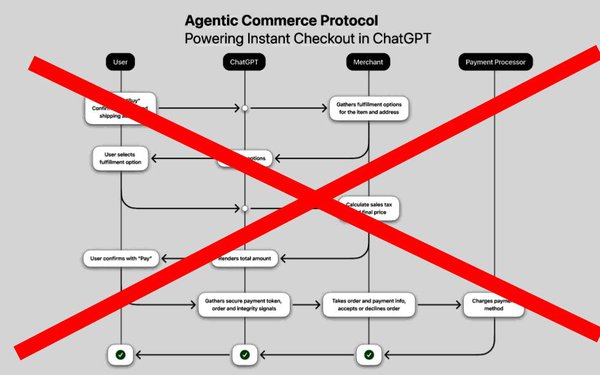
OpenAI apparently no
longer wants to handle commerce payments, cancellations, refunds, customer complaints and travel bookings. It appears that ChatGPT will send shoppers to merchant apps when they want to make
purchases.
Company executives seem to have shifted the company's commerce strategy -- moving its Instant Checkout feature announced in September and followed by attribution tools into apps run by
other companies, according to reports citing a TD Cowen research note published Thursday.
OpenAI's strategy had originally allowed users of ChatGPT to buy products and book
hotels in the chatbot. Now analysts are calling the chatbot a gateway to recommendations -- competing with Google Gemini, rather than the tool that processes purchases.
advertisement
advertisement
Retailers such as Amazon and Baidu may sell products, but AI assistants such as ChatGPT or Google Gemini will provide recommendations and become the shopping
gatekeepers.
OpenAI has not fully moved away from ecommerce. It is shifting toward partnerships and integrations that will handle the transaction.
The company has
partnered with Stripe, Shopify, Etsy and payment company PayPal to complete transactions.
Risk and liability may lead OpenAI in this direction, so it can support discovery and
recommendations. Handling payments includes dealing with fraud, shipping and refunds.
OpenAI CEO Sam Altman has not publicly confirmed OpenAI's change in direction, but he has spoken
about viewing ecommerce as part of ChatGPT's strategy to support merchants that want to retain customer relationships and checkout processes.
Visibility on ChatGPT is a major problem for
some companies and industries. About 83% of restaurants are invisible on ChatGPT, according to LocalFalcon, which monitors online visibility for engines such
as Google, ChatGPT, Apple Maps and others.
LocalFalcon analyzed 189,905 ChatGPT search results and compared them to more than 16 million Google results. The
gap proved massive, with results showing that more than 83% of restaurants do not exist on ChatGPT vs. 14% on Google. The few restaurants that were found dominated search results.
Some 45% of consumers now use AI for local recommendations,
up from 6% last year. They search on a platform where most options don't exist.
ChatGPT does not index businesses like Google and Microsoft. It identifies them through web browsing,
although it uses Bing Search to scan the live internet for top-ranking websites and news. It also prioritizes information from trusted platforms like Yelp, TripAdvisor, G2, and the Better Business Bureau.
ChatGPT looks for Schema markup on business websites, which helps the AI understand specific details including
addresses, hours, and pricing. It relies on businesses that were prominent in massive datasets used during its initial training.
This does not necessarily mean companies can be easily
found, an important element in ecommerce, not recommendations.